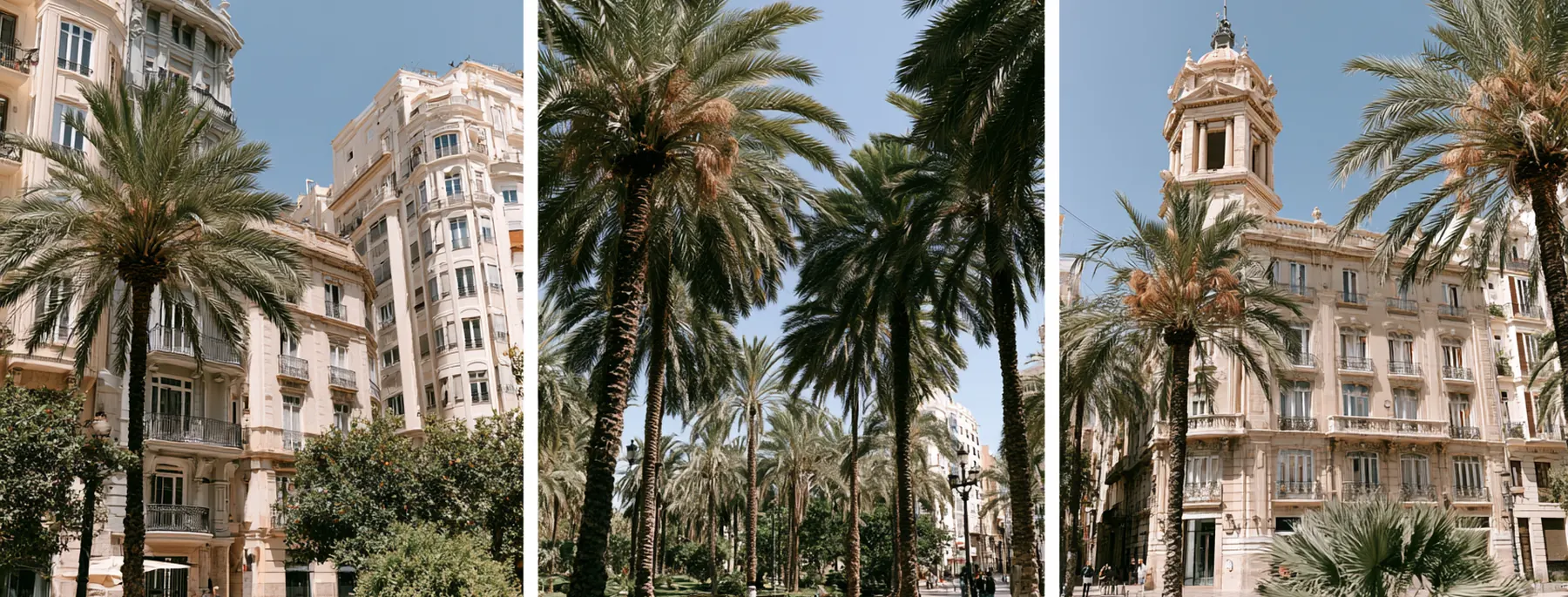
For many U.S. remote workers, contractors and founders, that is the real attraction. Not disappearing from professional life. Not giving up ambition. Not treating work as something unimportant. Quite the opposite: Spain offers a way to keep building your career while living in a place that reminds you, every day, that work is only one part of a well-lived life.
A different rhythm of daily life
Spain has a way of changing the texture of a normal day. A morning coffee is not just something you drink while rushing somewhere else. Lunch can still feel like a real pause. A walk after work becomes part of the day, not a luxury. Neighborhoods keep a natural social rhythm: the bakery, the café, the market, the square, the same faces slowly becoming familiar.
This may sound simple, but for someone working remotely it matters enormously. When your work happens on a screen, the world around that screen becomes much more important. The light in the room matters. The street outside matters. The possibility of closing your laptop and immediately feeling part of a real place matters. Spain does not remove responsibility. You still have clients, deadlines, contracts, invoices and decisions. But it softens the edges of the workday. It makes the hours around work feel more human.
Spain gives space back to life
One of the most beautiful things about Spain is that life happens outside. People walk. People sit in plazas. People eat together and stay out later than they planned. Children play in public spaces; older people occupy the same streets as everyone else; friends meet without needing an elaborate plan. A weekday evening still contains movement, conversation and warmth.
For remote professionals, this is surprisingly powerful. Remote work gives people flexibility: Spain gives that flexibility somewhere to land. You may start the day with deep work before U.S. meetings begin, take calls in the afternoon, still work hard, still grow the business. But when the workday ends, Spain offers more than the inside of another room. It offers streets with life in them. That is not a small thing.
A country of many lifestyles
There is no single way to live in Spain. That is part of its charm.
Madrid has energy, ambition and elegance; a capital that still knows how to enjoy itself. Barcelona has its own gravity: Mediterranean light, design, international energy, sea and architecture. Valencia increasingly feels like one of Europe’s most natural homes for remote workers: sunny, manageable, close to the sea, large enough to be interesting and small enough to feel livable. Málaga offers warmth, coastline and an easygoing confidence that has made it a magnet in recent years. San Sebastián is quieter, refined, Atlantic and deeply beautiful, a place where food, landscape and daily life seem to have reached a private agreement. Bilbao is modern, green and full of character, with mountains close by. And Seville, Granada, Alicante, Palma, A Coruña, Santander, Gijón, Girona, Cádiz: each offers another version of the same country.
That matters, because moving to Spain does not mean choosing a cliché. It means choosing the version of Spain that fits the life you want to build: sea or mountains, big city or slower city, international community or deeper local immersion, warm Mediterranean days or green northern landscapes. Spain gives you options without asking you to become someone else.
Beauty in the ordinary
Spain is not only beautiful in the obvious places. Yes: extraordinary museums, cathedrals, beaches, old towns. But the beauty that stays with people is smaller: the sound of a café in the morning, the first warm evening of spring, the smell of bread near a neighborhood bakery, a terrace where nobody seems in a hurry to leave, the way history appears casually around a corner without announcing itself.
For someone who has spent years optimizing productivity, calendars and output, that can be quietly moving. It is not dramatic. It is simply a reminder that life is not only something to be managed. It is something to be experienced.
A serious place for serious work
Spain’s emotional appeal does not make it unserious. It is a modern European country with strong cities, international companies, universities, hospitals, airports, digital infrastructure and a growing remote-work ecosystem. You can work from Spain seriously: serve U.S. clients, run a company, build a product, manage teams, advise, design, code, write, sell, invest and lead from here.
The difference is that around that work, Spain gives you a better setting for being a person. That is the real promise. Not less ambition — a better place from which to carry it.
The value of time
Spain has a particular relationship with time. Not because everything is slow. Spanish professional life can be demanding, fast and highly competent. But socially and culturally, daily life leaves more room for pauses. Meals matter. Family matters. Walking matters. Being outside matters.
For a remote professional, this can be transformative. A long lunch does not mean laziness. An evening walk does not mean lack of ambition. A life with more beauty does not mean a life with less discipline. Sometimes it is exactly the opposite. When life feels richer, work becomes more focused; when your environment gives something back, ambition feels less like pressure and more like direction. Spain does not do the work for you. But it makes the life around the work worth protecting.
Food, health and the pleasure of normal things
Food is one of Spain’s great daily gifts, and not just the famous restaurants. The real gift is that good food is woven into ordinary life: a simple menú del día, fresh produce, olive oil, fish, bread, fruit that tastes like something, a local bar that does not need to be fashionable to be good, a culture where eating together still matters.
For many people this changes more than their diet. It changes the pace of the day, how they meet friends, how they spend evenings. Spain also encourages movement in unforced ways: walking to places, going to the market, living in neighborhoods where errands don’t require a car, spending time outside because the outside is inviting. None of this is magic. But a better life is rarely built from one dramatic decision; it is built from hundreds of small daily improvements.
Community without constant performance
Moving countries can be lonely at first: building community takes effort, language, patience and humility. But Spain gives that effort a generous setting, with many doors through which life can enter: a terrace, a sports club, a language class, a coworking space, a cycling group, a school community, a local market, a regular café, a neighborhood festival, a football match watched with people who care far too much, which is exactly the point.
But the dream needs structure
Many U.S. remote professionals are not looking for a fantasy. They are asking a very human question: if my work can travel with me, could my life become better somewhere else? Spain answers that question compellingly. But this is where the practical side matters: a move to Spain should feel exciting, and it should not be improvised.
The more beautiful the idea, the more important it is to protect it with proper planning. Your immigration route, your work structure, your income evidence, your health coverage, your background documents, your tax position, your timeline. Nobody imagines a new life abroad because they enjoy apostilles and immigration forms. But those things matter because they allow the life to happen properly. They turn uncertainty into a plan. They turn “maybe one day” into “this is how I can do it.”
Why doing it properly matters
Spain is generous in many ways, but it is still a legal system. Documents matter. Deadlines matter. Employer letters matter. Insurance wording matters. Social Security treatment matters. A W‑2 employee needs employer cooperation; a 1099 contractor needs stable, documented client relationships; a founder needs to explain income and structure; a family needs extra documents and timing; a high earner needs tax planning before becoming resident.
Doing this properly is not about fear. It is about peace of mind, arriving in Spain able to enjoy the country, instead of constantly wondering whether something important was missed. Once the legal and practical structure is clear, you can return to the reason you wanted Spain in the first place: the light, the streets, the food, the sea, the mountains, the people, the sense that life can be full without being frantic.
A personal note
I believe Spain has something genuinely valuable to offer remote professionals. Not because it is perfect. It is not.
Spain is not the right country for everyone. If what you value most is speed, predictability and constant efficiency, some parts of daily life here may frustrate you. But if you’re looking for a better balance between ambition and everyday living, Spain offers something genuinely difficult to find elsewhere.
Because it allows many people to imagine a life where professional ambition and personal wellbeing do not have to be permanently in conflict. A country cannot make decisions for you. But the right country can change the atmosphere in which your life happens. Spain gives work a different background, gives time a different meaning, gives ordinary days more color, and gives people a reason to look up from the screen.
If you are going to build that kind of life here, even for a chapter, it deserves to be done carefully. Not casually. Not fearfully. Carefully, with the right visa route, the right documents, the right timing, and the right legal and tax questions asked before they become problems. Moving to Spain should not feel like jumping into the unknown. It should feel like stepping into a life you have chosen with intention.
The dream begins with a feeling. The life requires a structure. And when both come together (the emotion and the planning, the beauty and the legal clarity) Spain can become more than a destination. It can become home. If you’re still at the stage where you’re asking whether Spain could become home, that is exactly where everyone who has made the move started. The free assessment simply tells you whether the legal route exists to match the life you’re already imagining.
Last updated: 7 October 2026.