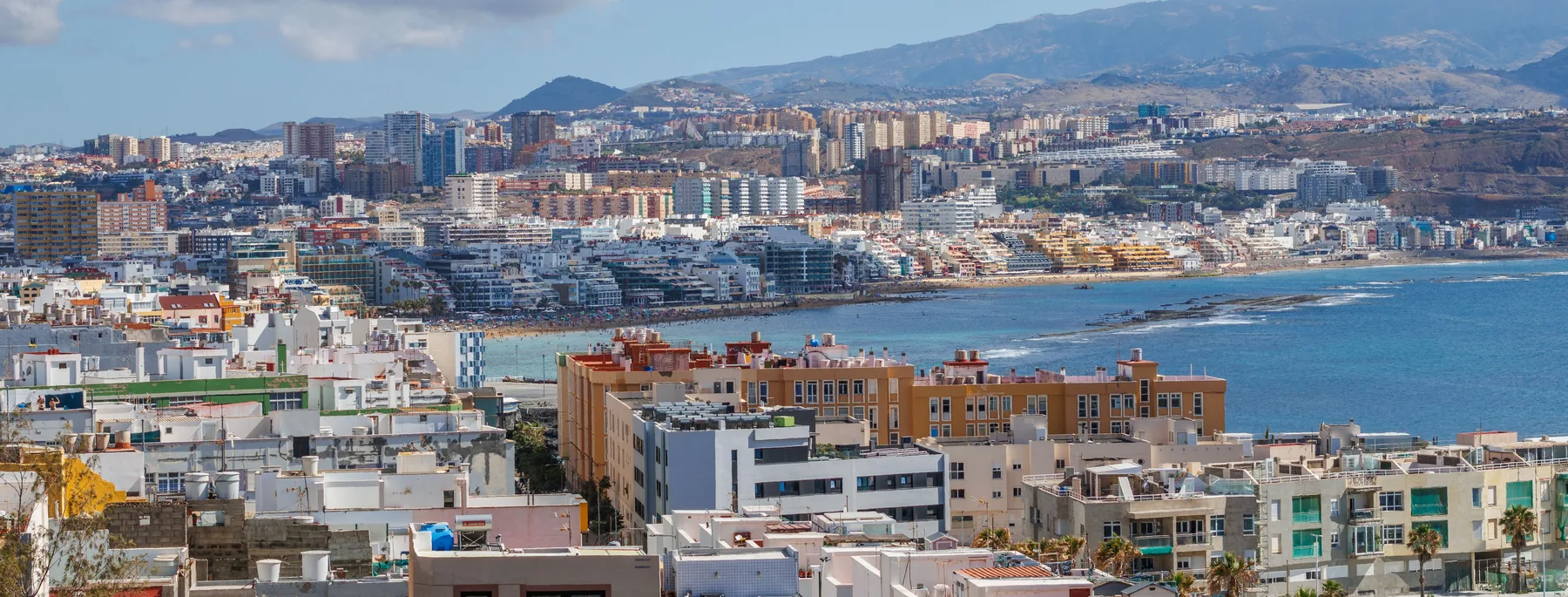
Why Las Palmas appears on every nomad list
There is a version of digital nomad hype that evaporates when you actually show up. Las Palmas is not that. Nomad List has ranked it consistently in the top five globally for years, and people who come for a month tend to stay for a year. The reasons are structural:
The climate is the most honest selling point in travel writing. Las Palmas is in the Atlantic, at the latitude of the Western Sahara, moderated by the trade winds. The result is a temperature range so narrow (rarely below 17°C in winter, rarely above 27°C in summer) that the city essentially has no seasons in the European sense. You wear the same clothes in January and July. Sunscreen is a year-round item. The sun comes out by 9am on most days. This is not a boast; it is a fact of geography.
Las Canteras beach is two kilometres of calm, protected Atlantic water running through the middle of the city. You can swim year-round. It is lined with restaurants and cafés. Walking distance from the beach to half the city’s neighborhoods. Urban beaches of this quality exist almost nowhere else in Spain.

The cost advantage over the mainland is real and consistent. Rent, groceries, dining out: all noticeably cheaper than Barcelona or Madrid, and in the same bracket as Valencia or Málaga but without the recent rent inflation those cities have seen. The DNV income threshold goes meaningfully further here.
The tax difference you need to understand
The Canary Islands are a Spanish autonomous community and an EU outermost region. They are fully part of Spain and fully part of the Schengen Area. But they operate under a separate indirect tax regime that has applied since before Spain joined the EU.
Instead of IVA (Spain’s standard VAT at 21%), the Canary Islands use IGIC — Impuesto General Indirecto Canario, at a standard rate of 7%. If you are self-employed (autónomo) and living in Las Palmas, your invoices carry IGIC at 7%, not IVA at 21%.
For most Digital Nomad Visa holders working primarily for U.S. clients, the practical impact is limited: services billed to businesses outside the EU fall outside IGIC just as they fall outside IVA. You do not charge IGIC on invoices to your U.S. clients, and an employee has no invoices at all.
Where IGIC matters: if you have any Spanish clients (up to 20% of income under the DNV rules), those invoices carry 7% instead of 21%, a material difference. And if you form a Spanish SL and have local commercial activity, the lower IGIC rate affects your pricing and cashflow. Your gestor in Las Palmas will be familiar with IGIC; confirm they are, and that they file Modelo 420 (the IGIC equivalent of Modelo 303) rather than the mainland forms.
Income tax works as on the mainland: IRPF is national, with the Canary Islands' own rates on the regional half, and the Beckham Law is the same regime. Moving to Las Palmas does not change your Beckham Law eligibility or application; it is processed through the same national AEAT system.
The ZEC: worth knowing, rarely relevant for new arrivals
The Canary Islands also have a ZEC (Zona Especial Canaria): a special economic zone that offers a 4% corporate tax rate (versus Spain’s standard 25%) for qualifying companies. To qualify, you must incorporate in the Canary Islands, make a minimum investment, create at least one local job, and operate in eligible sectors (technology, professional services, and others qualify).
For Digital Nomad Visa holders arriving in year one, the ZEC is almost never relevant. The requirements are substantial and the administrative overhead significant. For people with genuinely high income (€150k+) who intend to stay long-term and have the scale to meet ZEC requirements, it is worth a specific conversation with a local tax advisor after you have a full year of Canarian residency behind you. Do not let it influence your initial structure decision.
Neighborhoods
- Las Canteras / Guanarteme: The nomad epicenter. Two minutes from the beach, excellent café and restaurant scene, high density of coworking spaces, good walkability. Rents are the highest in the city here but still below mainland comparable neighborhoods. The default choice for most Digital Nomad Visa holders arriving in Las Palmas.
- Vegueta: The historic center, colonial architecture, the cathedral, the Casa de Colón (where Columbus stopped on his way to the Americas). Smaller apartments, more character, fewer services than Canteras. Beautiful to walk through; quieter as a base. Good choice for people who want history over beach proximity.
- Triana: The commercial and retail heart of the city. Well-connected, practical, pedestrian shopping streets. Midrange rents, good transit access. Less scenic than Canteras or Vegueta but excellent for daily life logistics.
- Ciudad Jardín / Alcaravaneras: Residential areas east of Las Canteras. Quieter than the beach neighborhood, slightly lower rents, still well-connected. Good for people who want proximity to the beach without being in the middle of the tourist-facing part.
- Schamann / Escaleritas: Working-class neighborhoods further inland. Significantly lower rents, local atmosphere, further from the beach. Good for people on tighter budgets who prioritize space over location.
Cost of living
- Rent (1BR, furnished, Las Canteras area): €750–€1,100/month
- Groceries: €200–€320/month (Mercadona, Hiperdino; local markets are excellent)
- Dining out: €8–€14/lunch, €25–€45/dinner at a proper restaurant
- Transport: €30–€40/month (bus network covers most of the city; walking and cycling are realistic in Las Canteras)
- Health insurance (DNV-qualifying): €70–€140/month
- Total estimate (comfortable single): €1,400–€2,100/month
These numbers are meaningfully lower than what the same quality of life costs in Barcelona or Madrid, and slightly below Valencia or Málaga.
Run your numbers
Gross-to-Net Salary Calculator
What your U.S. salary actually leaves in your pocket each month living in Spain.
Coworking and remote work infrastructure
Las Palmas has more coworking than a city its size has any business having, a direct product of the nomad crowd that put down roots here. Las Palmas Coworking, Coworking Canarias, The Mill, and several independent spaces operate across the Las Canteras area and the center. Monthly passes run €80–€150. Café culture is strong enough that many remote workers never use a dedicated space. Fiber internet in apartments is reliable and fast.
Getting around and off the island
Las Palmas does not have a metro but the bus network (Guaguas Municipales) covers the city well. The island itself requires a car or the interurban bus network to explore. Gran Canaria Airport (LPA) is 25 minutes from Las Canteras and has direct connections to Madrid, Barcelona, London, Frankfurt, Amsterdam, and most major European hubs, typically with competitive fares given the volume of charter and scheduled traffic. Getting to mainland Spain for a long weekend is easy and affordable.
Is Las Palmas right for you?
Las Palmas is right for people who want a genuinely functional nomad ecosystem rather than an experiment, can use the lower cost of living strategically, and find the eternal spring climate appealing rather than monotonous. It is right for people who would thrive at a beach that is walkable from their desk.
It is wrong for people who want deep mainland Spanish culture (the Canarian culture is distinct from Castilian, Catalan, or Andalusian Spain), who require the professional-services depth of Madrid or Barcelona, or who specifically want Spanish city life rather than a mid-Atlantic island city.
Last updated: 27 September 2026.