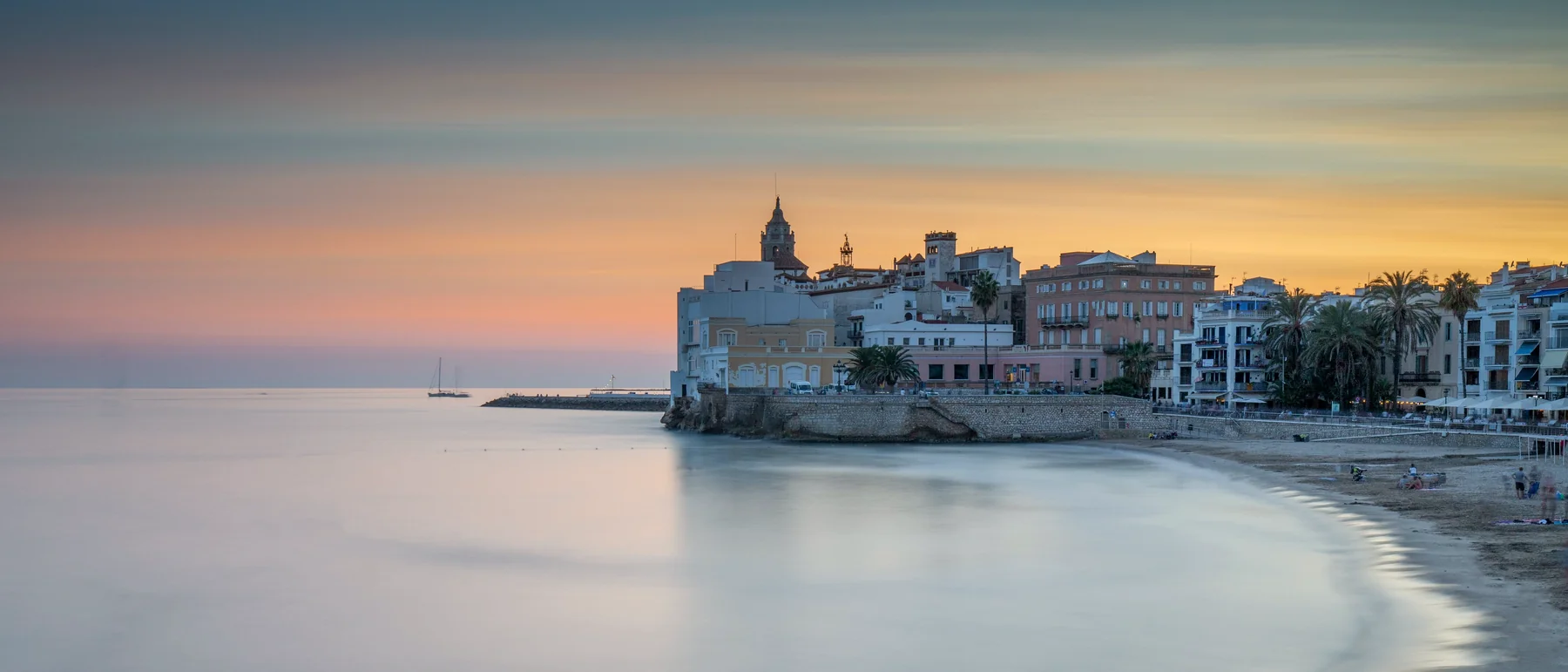
Why Americans and Canadians choose Sitges
The beach, the old town and the seafront promenade are a few minutes' walk from each other. You buy bread, swim and meet friends on foot. When you need more than the town has, you take the train.
The foreign community is large and settled. On 1 January 2026 the INE counted 9,073 foreign residents in a town of 32,795. Among them were 1,076 British, 840 French and 432 U.S. citizens. Americans make up about 1.3% of the town, roughly ten times their share in Spain as a whole. Sitges also has a long reputation as an LGBTQ-friendly place.
Flying home is easy. Barcelona-El Prat is the nearest airport, with nonstop flights to the U.S. East Coast. Some routes only run in season, so check yours before you plan around it. From Canada, Air Transat has flown to Montreal all year since late October 2026, twice a week in winter, and Air Canada’s Toronto flights are seasonal. If you hold a Canadian passport, read what changes for Canadians.
Neighborhoods to know
- Centre (old town and seafront): the beach, cafés and the station on foot. The highest rents, and the most summer noise.
- Aiguadolç: quieter, by the marina. Also expensive.
- Vinyet and Terramar: leafy and more suburban, at the west end, with larger homes near the beach.
- Can Girona and Quintmar: on the hillside. Views and privacy, but a car or a good bike helps.
- Vallpineda and La Levantina: more space for the money, further out. You will need the bus or a car.
- Garraf and Les Botigues de Sitges: separate pockets on the coast toward Barcelona, with many seasonal rentals.
These are broad impressions. Look at listings street by street before you decide.
Cost of living in Sitges
Rent decides whether Sitges works for you. Asking rents for apartments averaged €15.46 per square meter in November 2026 (Engel & Völkers). New leases registered in 2025 averaged €1,295 a month across all sizes, according to Catalonia’s register of rental deposits (Incasòl, published by Idescat). Here are the fixed monthly costs for one person:
- Rent (1BR, 50–70 m²): €775–€1,080/month (Engel & Völkers, November 2026)
- Utilities: about €148/month for 85 m², less for a smaller flat
- Home broadband: about €31/month
- Local transport pass: €25/month
- Gym: about €55/month
- Eating out: about €15 for a meal in an inexpensive restaurant, €60 for a mid-range dinner for two
- Fixed costs before food and leisure: roughly €1,030–€1,340/month
Everything except rent comes from Numbeo. Its Sitges page had five contributors in 18 months and was last updated in July 2025, so treat it as a rough guide. Health insurance is not included, because whether you need it depends on your Social Security route (see below). What the visa asks you to earn is in the income requirements guide, and the full bill for the move is in what the visa costs an American. Before you sign a lease, read renting or buying on the visa.
Run your numbers
Gross-to-Net Salary Calculator
What your U.S. salary actually leaves in your pocket each month living in Spain.
Coworking and working from home
The coworking scene is small. Expect to work mostly from home. When you want more choice, Barcelona’s coworking spaces are a train ride away.
International schools for families
Three British-curriculum schools are in or next to Sitges. BSB Sitges, a campus of The British School of Barcelona, goes from pre-nursery to the end of primary. Older pupils continue at the school’s other campuses, the nearest in Castelldefels. Richmond International School in Sant Pere de Ribes goes from nursery to Year 13, at age 18. The Olive Tree School, also in Sant Pere de Ribes, covers ages 3 to 16. Public schools in Catalonia teach mainly in Catalan. Bringing your family? Read the Digital Nomad Visa with family first.
Healthcare
Primary care is at CAP Sitges. The nearest public hospital is Hospital Residència Sant Camil in Sant Pere de Ribes, the next town inland. For complex care, Barcelona’s large hospitals are a train ride away.
Access depends on your file. With an SSA Certificate of Coverage you stay in the U.S. system and have no access to Spanish public healthcare. You need private insurance from an insurer authorized in Spain. If you register with RETA, or your employer registers you in Spain, you get public cover.
Taxes in Catalonia
Catalonia is common territory. On the ordinary rules, income tax adds the state scale and the Catalan regional scale, whose top rate is 25.5%. The top combined marginal rate comes to about 50%, among the highest in Spain. Employees who qualify for the Beckham regime pay 24% on their employment income up to €600,000, the U.S. salary included, and 47% above. The Catalan scale does not apply to them. The Beckham regime does not exist in the Basque Country or Navarre, which have their own foral tax systems. Catalonia is not one of them.
The honest version
- Rent: high per square meter, and seasonal lets compete with long-term ones.
- Summer crowds: Idescat estimates that in 2024 the town held about 5,000 more people than its registered population, on a full-time basis.
- Winter: the town goes quiet, and the choice of coworking, secondary schooling and specialist care is thin all year.
- Catalan first: town hall paperwork starts in Catalan.
- The train: anything Barcelona offers depends on the R2 Sud line.
Filing the Digital Nomad Visa from Sitges
Where you live does not change where the file goes. Every in-Spain application is decided by the same national unit, the UGE, with the same documents and the same ~20 business day timeline. If you are already in Sitges as a tourist, the 90-day Schengen clock is running. The steps, in order, are in how to apply, step by step, and your first weeks are in the first 30 days.
Retiring rather than working? The Non-Lucrative Visa is requested before you move, at the Spanish consulate for your state. Retiring in Spain from the U.S. walks you through it. Once you arrive, the local steps below are the same.
Padrón. You register at the town hall’s citizen office (OAC), Carrer Nou 12, by appointment. Bring your passport and proof of your address in Sitges. Non-EU residents without permanent residence must renew it every two years. The general process is in how to register your empadronamiento.
TIE. Sitges is in Barcelona province. You book the fingerprint appointment for your TIE on the Extranjería appointment site, choosing Barcelona as the province and then an office from the list. Pick the nearest one with free slots, and check the address on your appointment receipt.
Is Sitges right for you?
Sitges suits you if you want a beach town with a big international community and can carry the rent. Families with young children do well here, with British schools close by. It suits you less if you want city energy every day, or work best surrounded by other remote workers. For that, Barcelona is 40 minutes up the line.
Other places to compare. Girona is a small Catalan city with lower rents and a fast train to Barcelona. Jávea, on the northern Costa Blanca, has an even larger foreign share. Fuengirola, Mijas and Benalmádena offer the beach with daily life in English. If you want winter sun, read the Canary Islands guide. All of them sit side by side in the best Spanish cities for remote workers.
Living in Sitges does not change the visa. Start with the free assessment and I will tell you within 24 hours whether your profile fits and what to order first.
Questions about living in Sitges
Yes, if you want a walkable beach town with a large international community and Barcelona close by. On 1 January 2026 the INE counted 432 U.S. citizens among Sitges' 9,073 foreign residents. The catch is rent, which is high for a town this size.
A one-bedroom of 50 to 70 m² rents for about €775 to €1,080 a month at Engel & Völkers' November 2026 asking prices. Add utilities, home internet, a local transport pass and a gym, and one person’s fixed costs come to roughly €1,030 to €1,340 a month before food.
The R2 Sud train takes 36 to 42 minutes to Barcelona Sants. There are about four trains an hour, and up to six at the morning peak.
Yes. Winter is calm, with average highs of about 14°C (57°F) in January at the Barcelona airport weather station. Summer is the opposite: Idescat estimates that in 2024 the town held about 5,000 more people than its registered population, on a full-time basis.
Yes, three British-curriculum schools are in Sitges or next door in Sant Pere de Ribes. BSB Sitges covers pre-nursery to the end of primary, Richmond International School goes up to age 18 and The Olive Tree School covers ages 3 to 16. Public schools in Catalonia teach mainly in Catalan.
Yes. The file goes to the UGE, a single national unit, so the documents and the timeline of around 20 business days are the same anywhere in Spain. Locally, you register on the padrón at the town hall’s citizen office on Carrer Nou and book your TIE fingerprints at an Extranjería office in Barcelona province.
Last updated: 28 November 2026.