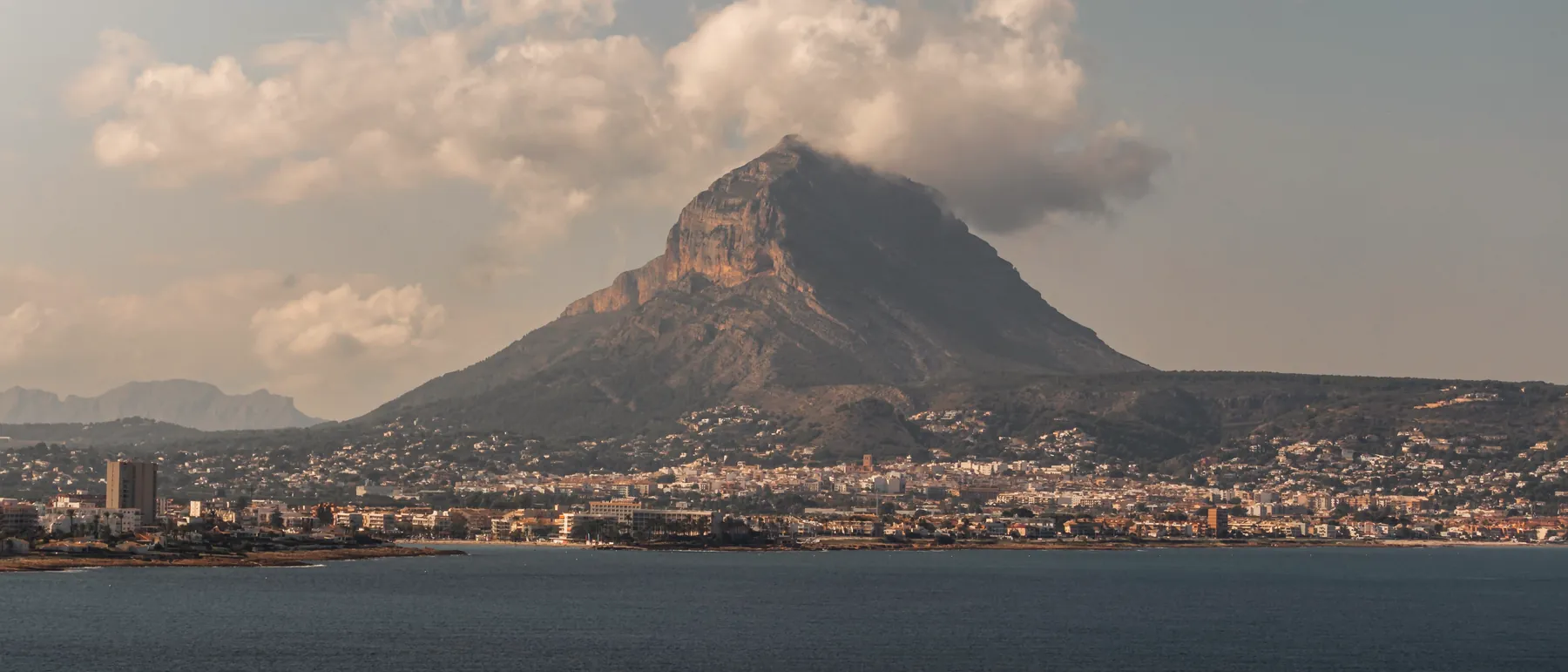
Why Americans and Canadians look at Jávea
Foreigners have settled here for decades. INE counts 4,488 British residents in Jávea at 1 January 2026, plus 231 Americans and 55 Canadians. Add Dénia, Altea, Calp, Teulada and Benissa and the area holds 763 Americans and 164 Canadians. Some neighbors have an even higher foreign share: 62.0% in Benitachell, 56.6% in Teulada (Moraira) and 54.8% in Calp.
Many doctors, banks, builders and real estate agents work in English. The Montgó shelters the town from the north. Unlike Alicante, this is a small town, and you notice it most in how you get around.
Best areas to live in Jávea
Jávea grew around three cores. Outside them, you need a car.
- Old Town (el Poble): About 2 km inland from the port. Most year-round residents live here. Shops stay open all year and you can walk everywhere.
- The Port (Duanes de la Mar): Sea views, flat walks and La Grava, a shingle beach.
- The Arenal: The sandy-beach district. It is the warmest spot in winter and the busiest in summer.
- The urbanizaciones: The Montgó slopes, Balcón al Mar, Tosalet, Cap Martí, Portitxol and Rafalet. Villas with views and real quiet, and not one errand you can do on foot.
Without a car, pick the Old Town, the Port, the Arenal or upper Cala Blanca. With one, remember that your U.S. license only lasts a while after you become resident. The driver’s license guide explains the exchange.
Cost of living in Jávea
Jávea is pricey for the region. In June 2026 idealista put asking rents at €14.5 per m², against €13.2 for the Valencian Community as a whole. A realistic monthly budget for one person:
- Rent (1BR, 50 to 70 m²): €750–€1,000/month
- Electricity, water and trash: about €154/month for an 85 m² apartment, from €100 to €238 (Numbeo, Jávea)
- Home internet (60 Mbps or more): about €27/month
- Mobile plan (10 GB or more): about €10/month
- Everyday spending (food, eating out, transport, leisure): about €730/month (Numbeo’s estimate for Alicante; Jávea has too few entries)
- Total estimate (one person, rent and everyday spending): €1,500–€1,750/month
Numbeo doesn’t say whether its everyday figure includes utilities, so budget for them on top, and for a car. Private health insurance, where your route needs it, is priced by age. If you are retiring, check your savings against the Non-Lucrative line below.
Check your means
Non-Lucrative Visa Calculator
Savings plus Social Security or a pension, against Spain’s 2026 line for your household. In euros, with the renewal.
Coworking and internet
The coworking scene is small. Coworking Jávea, on Carrer Alameda near the port, charges €30 a day or €149 a month plus VAT for an open desk, and members get 24/7 access. Sun and Co has run a coliving in a 19th-century house by the Old Town since 2015, with a minimum stay of 14 nights. Most remote workers here work from home, so test the connection at the address before you sign.
International schools
There are two British schools, both accredited by NABSS. Xàbia International College, in town, takes ages 2 to 18 and teaches the British and Spanish curricula. The Lady Elizabeth School, at Cumbre del Sol in neighboring Benitachell, also covers 2 to 18, through GCSEs and A levels. Ask each school for its current fees. Public schools are free and teach in Valencian and Spanish, with English. Moving with children? The family guide covers their side of the file.
Healthcare in Jávea
The public hospital is in Dénia. The regional health service has run it directly since 1 February 2024. In town, the Jávea Pueblo health center has 24-hour urgent care. For private care there is HLA San Carlos in Dénia, with a clinic in Jávea.
Your visa route decides which system you use. With the Digital Nomad Visa and an SSA Certificate of Coverage you are outside the public system and need private insurance from an insurer authorized in Spain. If you pay into RETA as self-employed, you are inside it. On the Non-Lucrative Visa the consulate asks for private cover without copays, and the health insurance guide explains what passes.
Taxes
Jávea is under the common state tax system, with the state scale plus the Valencian one. An employee who qualifies can opt for the Beckham regime: 24% on work income up to €600,000 and 47% above. Beckham does not apply in the Basque Country or Navarre, which have their own foral systems; Jávea, Dénia and Altea are not affected. A freelancer usually does not qualify. A retiree who becomes tax resident pays the progressive scale on worldwide income. A U.S. citizen keeps filing with the IRS either way.
Padrón and TIE in Jávea
You register on the padrón at the town hall’s citizen service office (Oficina de Atención Ciudadana), next to the Old Town. It opens weekday mornings. Bring your passport, your NIE or TIE if you have one, and proof of address: a rental contract in Spanish, or the deeds with a recent IBI or AMJASA water bill. A non-EU resident without long-term residence renews it every two years. The empadronamiento guide walks through the rest.
The TIE fingerprinting appointment is booked on the Policía Nacional website, province of Alicante. Jávea has no station of its own. The nearest is the Comisaría de Dénia, C/ Castell d’Olimbroi 5, about 12 km away, but take whichever office in the province the system offers first. I send you the EX-17 and the 790-012 fee form already filled in. You book the appointment and go in person.
Living in Dénia instead
Dénia is the bigger neighbor, 12 km north. It has 48,583 residents, 30.5% of them foreign nationals and 178 of them American (INE, 1 January 2026). It is the area’s working town, with the district hospital, the police station and a ferry port. Baleària sails from Dénia to Ibiza and to Palma all year.
Rents run a little lower than in Jávea. idealista put Dénia at €12.4 per m² in June 2026, about €620–€870 for a one-bedroom of 50 to 70 m². For work, coworkZINQ sits in the center at Passatge de París 2, with day passes from €12 and flexible desks from €150 a month, plus VAT. CO-CO Coliving & Coworking Costa Blanca is on the hillside toward the Montgó, with a pool and a minimum stay of seven days. The two British schools of Jávea and Benitachell are a short drive away.
Living in Altea instead
Altea is about 40 km south of Jávea, some 45 minutes by car. Its whitewashed old town climbs a hill above the sea. It has 25,513 residents, 40.5% of them foreign nationals and 156 of them American (INE, 1 January 2026). Alicante airport is closer from here, about 70 km away.
idealista put Altea at €13.0 per m² in June 2026, about €650–€910 for a one-bedroom. LAB Altea, on Carrer Costa Blanca by the beach, calls itself the first coworking in Altea and the Marina Baixa. A flexible desk costs under €100 a month plus VAT, on weekdays. Benidorm, the district’s main town, is 15 minutes away. Choose Altea if you want to live nearer Alicante than Dénia.
Flying home to the U.S.
Alicante airport is about 105 km from Jávea, roughly an hour and a half on the AP-7. Valencia airport is about the same drive. There is no nonstop from Alicante to the U.S., so expect one stop, usually in Madrid. United plans a seasonal Newark to Valencia nonstop from 2 June 2027, three times a week until early October. Check it with United before you plan around it.
Filing your visa from Jávea
The Digital Nomad Visa filed inside Spain goes to the UGE, one national unit, so a file from Jávea takes the same time as one from Madrid: about 20 business days. If you are here as a tourist, file with room left in your 90 Schengen days. The step-by-step application guide lays out the order. If you are Canadian, the Digital Nomad Visa is your route, and the page for Canadians covers what changes. The Non-Lucrative Visa is for U.S. citizens. You apply at the Spanish consulate for your state before you move, and the TIE follows within a month of entry. The guide to retiring in Spain covers that route.
The downsides of living in Jávea
- Distance: the hospital, the TIE and most paperwork are in Dénia or Alicante.
- Seasons: crowded in July and August, quiet in winter.
- Autumn storms: most rain falls in short gota fría storms. On 19 October 2026, during storm Adam, firefighters evacuated a campsite in Jávea.
- Few Americans: the foreign community you will meet is mostly British and European.
Is Jávea right for you?
Jávea suits you if you want a small, beautiful town with services in English and you don’t mind driving. Pick Dénia for more town around you, or Altea to be nearer Alicante. If you would rather live without a car, Valencia and Alicante work better. So do Fuengirola on the Costa del Sol and Sitges near Barcelona, both beach towns on a train line. If you want somewhere quieter still, read the guide to rural Spain. The other options are on the cities page.
Where you live does not change whether you qualify. Start with the free assessment, or the Non-Lucrative version if you are retiring. I will tell you within 24 hours which visa fits and what to order first.
Questions about living in Jávea
Yes, if you want a small coastal town where services work in English and you don’t mind driving. Almost half the town are foreign nationals, mostly British and European. INE counted 231 Americans and 55 Canadians in Jávea on 1 January 2026, so you won’t meet many compatriots.
A one-bedroom of 50 to 70 m² rents for about €750 to €1,000 a month at idealista’s June 2026 asking prices. Add everyday spending and one person needs about €1,500 to €1,750 a month, plus utilities, a car and, on some visa routes, private health insurance.
Outside the Old Town, the Port and the Arenal, yes. In the hillside urbanizaciones you can’t do a single errand on foot, and the hospital and the police station are in Dénia, 12 km away. Your U.S. license only covers you for a limited time once you are resident, so look at the license exchange rules early.
Jávea is smaller, with the bigger foreign share and two British schools close by. Dénia is the working town, with the hospital, the police station, a ferry port, more coworking and slightly lower rents. Altea, further south, puts you closer to Alicante airport.
Fly into Alicante or Valencia, each about an hour and a half by car. Neither has a nonstop to the U.S. today, so most trips connect in Madrid. United plans a seasonal Newark to Valencia nonstop from 2 June 2027.
Last updated: 28 November 2026.