Why villages are opening their doors
Much of rural Spain has been losing people for decades. Remote work changed the math. A village with fiber, an empty stone house and a few kind neighbors can give you something a big city rarely does: people who notice you arrived and say good morning by name.
This guide is about places and what life in them is like. If your question is whether a region will pay you, the guide to regional grants goes through every program. If you want a small place but not a tiny one, towns like Tarifa, Jávea and Sitges have their own guides. And if you are still choosing between cities, start with the city comparison and the city guides.
Benarrabá and Rooral, in the hills of Málaga
Benarrabá is a white village of about 460 people in the Genal Valley, in the hills of the Serranía de Ronda. It is the best documented case in Spain of a village that sets out to welcome remote workers. The Rooral association has its permanent base here, working with the town council and the neighbors. In 2025 it hosted 52 remote workers from 19 countries, according to The Objective.
Stays run from two weeks to two months, in spring and autumn. Guests live in three village houses and work from a coworking space two minutes' walk away. Euronews (July 2024) found them making goat’s cheese, learning how cork is stripped from the trees and eating dinner with the village elders. Rooral’s website listed private rooms from €43 a day and shared rooms from €30 a day when we checked in November 2026. The full story is in our guide to Benarrabá. For life on the coast below, see the Málaga and Fuengirola guides.
Galicia: Sende, Anceu, iSlow and the Fixar network
Galicia has the most complete rural coliving scene in Spain, with the regional government behind it. Fixar is a program of the Xunta de Galicia and the Asociación Cultural Sende. It ran a pilot with 60 participants in 2024 and a second edition with 80 in 2025, and the Xunta confirmed a 2026 edition in May. Participants get a 15-day stay and professional mentoring. The stay is a scholarship, and food runs about €10 to €14 a day.
There is a catch. Fixar is open to people registered on the padrón in Galicia, with priority for those who live in a village or want to move to one. So you join after you settle. The three houses at its heart take guests directly, though.
- Sende sits in a hamlet of about 20 people near the Portuguese border, in Ourense province. It calls itself probably the oldest rural coliving in the world, and it has two coworking rooms and long communal dinners. Its 2026 coliving season ran in June, August and September until 15 October, and the site already takes bookings for 2027.
- Anceu Coliving opened in July 2020 in a hamlet of about 100 people, 30 minutes by car from Pontevedra. Stays run 15 to 60 days. A private room with its own bathroom costs €600 a month from January to March, €900 in spring and autumn and €1,200 in summer, with 1 Gbps fiber, coworking and cleaning included. Vigo airport is about 45 minutes away.
- iSlow is a renovated old stone farmhouse a few minutes from Laxe, on the Costa da Morte. The hosts live there with their children, and guests describe it as a good place for kids, which helps if you travel as a family. A Coruña, the provincial capital, is the nearest city with its own guide.
Bring a raincoat and plan on a car. Rural Galicia is green for a reason, and buses between hamlets are few.
The welcoming villages network, and Sigüenza
The Red Nacional de Pueblos Acogedores para el Teletrabajo began in 2021 with 27 founding towns. It is run by El Hueco, an organization that works on rural development, and Spain’s Ministry for the Ecological Transition subsidizes it. Its website lists 77 villages of up to 5,000 people and 1,333 registered remote workers. Each village has a local host who helps you settle, and each listing shows whether its workspace is open, its mobile coverage and a weekly cost of living estimate.
Do not expect a crowd of nomads. You get someone who answers your questions and a real village life, which may be exactly what you want.
Sigüenza is the most practical starting point for an American or a Canadian. It is a medieval town in Guadalajara of about 4,900 people, counting its outlying hamlets (INE, 2025), with a cathedral, a hilltop castle that is now a parador hotel and regional trains to Madrid’s Chamartín station. When we checked in November 2026 its workspace was listed as open and the network estimated living costs at about €242 a week per person. Check the current train times on Renfe before you plan your week around them.
Does Spain pay you to move to a village? Extremadura’s grant
In 2024, headlines said a Spanish region would pay remote workers up to €15,000 to move there. That region is Extremadura, on the border with Portugal, and the real offer has more conditions than the headlines. It is the only region we know of that has paid remote workers to move in. Under Decreto 119/2024, it paid €10,000 to women, people under 30 and anyone settling in a municipality of fewer than 5,000 people, and €8,000 to everyone else, in exchange for 24 months of residence. The Junta says more than 400 remote workers registered in Extremaduran towns under that first call, which closed on 8 October 2025.
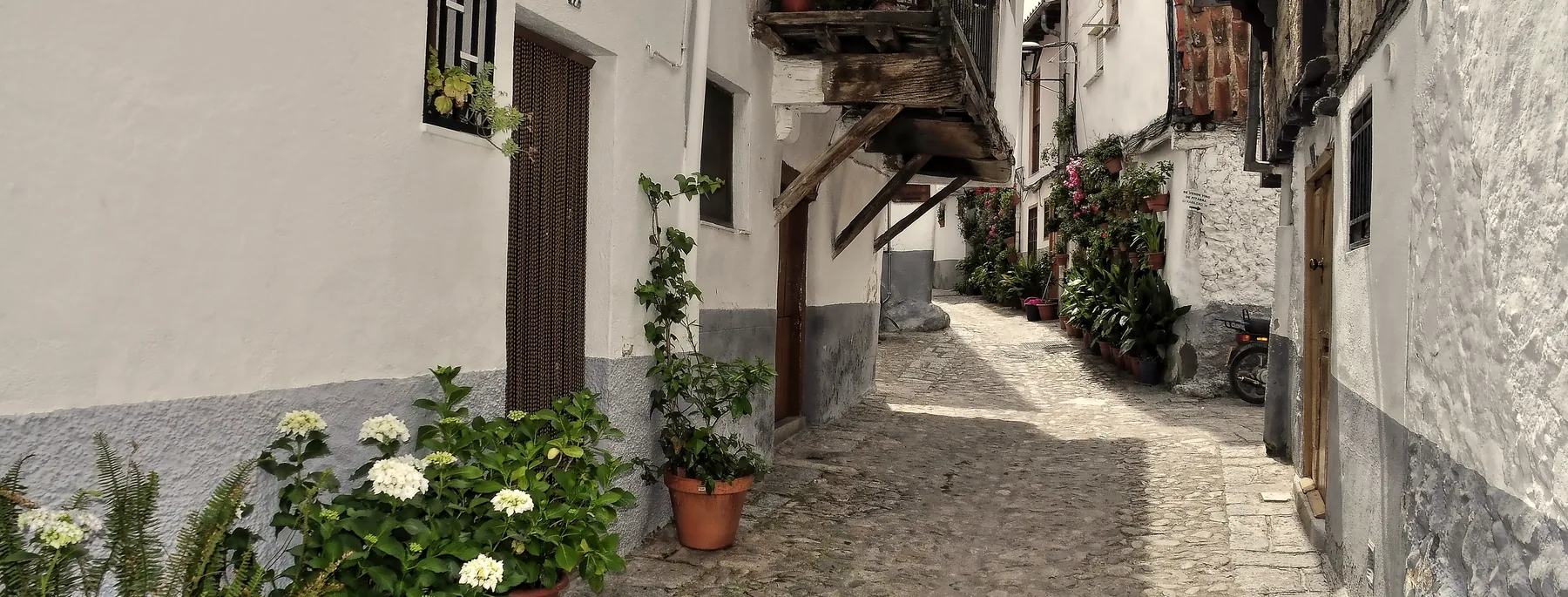
Hervás, the village in the photo at the top of this guide, is one of those small municipalities. It has about 3,900 people (INE, 2025), an old Jewish quarter of steep, narrow streets and chestnut woods all around, in the Valle del Ambroz in the north of Cáceres. Under the first call, a remote worker settling there could apply for the €10,000 amount.
On 28 October 2026 the Junta published the draft of a new call with €4.5 million for 2026 and 2027. It keeps the €10,000 and €8,000 and adds €5,000 or €4,000 for staying a third year, so under the draft the most you could receive is €15,000 over three years. It was still a draft under public consultation when we checked. Three changes matter if you are moving from abroad:
- You must have lived outside Extremadura for the 18 months before you settle there. The first call asked for six.
- You must already live in Extremadura and be on the padrón before you apply.
- You must move your tax home there and pay income tax in Extremadura. If you plan to use the Beckham regime, which is not available in the Basque Country or Navarre, ask the SEXPE how this condition reads for you before you count on both.
Under the first call, applicants from outside the EU needed a NIE and, at payment, Spain’s international remote work visa or permit. In other words, the visa comes first and the grant second. The grants guide has the full table.
Oliete, the village of the adopted olive trees
Oliete, in Teruel, had about 250 people when Euronews visited in December 2024. The Apadrina un Olivo project invites people around the world to sponsor one of its old olive trees, and with €71,000 from sponsors and €75,000 of public and business support it turned an old cowshed into a coworking space. Euronews counted 43 new jobs and 19 new residents in a year. The school had three pupils when the project started and 27 when the reporters came.
Oliete belongs to the welcoming villages network, but its workspace was listed as closed when we checked, so write before you go. It suits someone who wants to put down roots. If you would rather keep a city within reach, Aragón’s capital has its own Zaragoza guide.
Hamlet’s Friends, an hour from Madrid
In Nuño Gómez, a small village in Toledo province, Hamlet’s Friends turned a former golf course into a coliving and coworking space with wooden cabins, rooms in a country house and an organic vegetable garden. Escapada Rural described it in May 2026: mostly international guests aged roughly 30 to 55 who stay for weeks or months, community dinners, movie nights, hikes and the village’s own festivals. It is an hour from Madrid, its airport and its city life, which makes it the easiest rural trial of all.
Catalonia and Cantabria
Cowocat Rural is a network of more than 50 rural coworking spaces across Catalonia, promoted since 2015 by the region’s eleven LEADER groups. These are village coworkings, so expect a desk and Catalan or Spanish around you, not an English-speaking scene. Girona is the closest city guide for the north of Catalonia. L’Espai Barrina, in the Serra de Castelltallat, joined in 2026 and offers coworking and coliving in a converted family farmhouse, with a garden and a pool.
PAS Rural Coliving sits in Villegar de Toranzo, a village of fewer than 100 people in Cantabria’s Pas valleys, about 40 minutes from Santander. Six wooden cabins house up to 20 people, a former garage is now the coworking room, and most guests stay one to three months. It is a nonprofit and asks for a monthly contribution of €790, €980 or €1,200 depending on what you can pay.
Village life on the islands
A quiet place in Spain does not have to be inland. On Fuerteventura, Lajares is a small surf village about ten minutes from Corralejo, with cafés and a coworking. Tenerife’s north, around La Orotava, is greener and quieter than the resorts of the south, and daily life there runs more in Spanish. The Canary Islands guide compares the islands, and the Fuerteventura and Tenerife guides go town by town.
A month or three years? An honest look
A month in a village feels easy because someone else has solved the hard parts. For three years, you solve them yourself.
| Question | For a month | For three years |
|---|---|---|
| Healthcare | Travel insurance and the village clinic for small things | Find out where the nearest hospital is and whether your insurance pays there. It can be an hour away |
| Car | Depends on the house. Ask how guests get around | Usually essential. A non-EU license is generally valid for about six months after you become resident |
| Padrón | Not needed | Needed for the TIE and for most local programs. Make sure your lease lets you register |
| TIE | Not needed | You apply in person at the police unit of your province, which can be a long drive |
| Internet | The coliving’s fiber | Check fiber at your exact address. Gigabit reaches 86% of rural homes |
| Community | Built in | You build it, often in Spanish |
None of this should put you off. A gentle way to choose is in two steps. Spend a month or two in a coliving to learn the region, then rent a house nearby once you know which valley you love. The guides on registering on the padrón, healthcare, driving with a U.S. license and renting or buying cover each step, and your first 30 days puts them in order.
The permit is the same in a village
A month in a coliving fits inside a normal visit. Living in a village takes a residence permit. For a U.S. or Canadian remote worker, the natural route is Spain’s Digital Nomad permit: you keep working for your employer or clients outside Spain and choose where in Spain to live. It can be filed from inside Spain, and a village address does not change what the application has to prove. If you are an American who will not be working, the Non-Lucrative Visa is the usual path, and the guide to retiring in Spain from the U.S. covers that move.
The step-by-step guide explains the process, and the income threshold and health insurance have their own guides. If a village is calling you, the free assessment tells you whether your work and income fit the permit before you spend anything. I read every answer myself.
Questions people ask
Yes. The permit lets you work remotely for an employer or clients outside Spain and live anywhere in the country, a village included. For a long stay you need an address where you can register on the padrón, because the TIE asks for it. If you are an American retiring rather than working, the Non-Lucrative Visa lets you live in a village too.
The best documented are Benarrabá in Málaga, with Rooral, and Galicia’s rural colivings: Sende, Anceu and iSlow. The Red de Pueblos Acogedores lists 77 villages with a local host, Sigüenza among them. Hamlet’s Friends near Toledo and PAS Rural Coliving in Cantabria are other options.
Not right now. The offer behind the headlines is Extremadura’s grant for remote workers. Its first call, which paid €8,000 to €10,000 for two years of residence, closed on 8 October 2025. A new call with €4.5 million for 2026 and 2027 was published as a draft on 28 October 2026. It asks for 18 months living outside Extremadura, a padrón there before applying and income tax paid in Extremadura.
Only once you live in Galicia, because Fixar is open to people registered on the padrón there. Before that, you can book Sende, Anceu or iSlow directly like any other guest.
Often, but check the exact house. Gigabit broadband reaches 86% of rural households, against almost 95% nationally, according to Spain’s 2025 coverage report. Ask for a speed test from your desk and keep mobile data as a backup.
For a month in a coliving, English gets you far. For a life there, yes. Neighbors, the town hall and the village clinic will mostly speak Spanish, or Galician or Catalan in those regions, and even a little opens many doors.
Sources: Red Nacional de Pueblos Acogedores, checked 27 November 2026 · Red Eléctrica, 24 June 2021 · The Objective, 2 December 2025 · Rooral · Fixar · Xunta de Galicia, 29 March 2025 and 30 May 2026 · Sende · Anceu Coliving · iSlow on Cocohub · Junta de Extremadura, grant page and 28 October 2026 · Euronews, 23 August 2024 · Euronews, 7 December 2024 and 20 July 2024 · Escapada Rural, 7 May 2026 · NacióDigital, 25 June 2026 · Cantabria Económica, 14 March 2026 · PAS Rural Coliving · Ministry for Digital Transformation, 2025 broadband coverage report, May 2026 · Ministry of the Interior, TIE. Last updated: 28 November 2026.