Why remote workers end up in Tarifa
The old quarter still sits inside its medieval walls, around the Castillo de Guzmán el Bueno. The streets are narrow and white, and the squares are small. Walk out along the causeway to the Isla de las Palomas and you are standing at the southernmost point of continental Europe. Across the water, the mountains of Morocco change color all day.
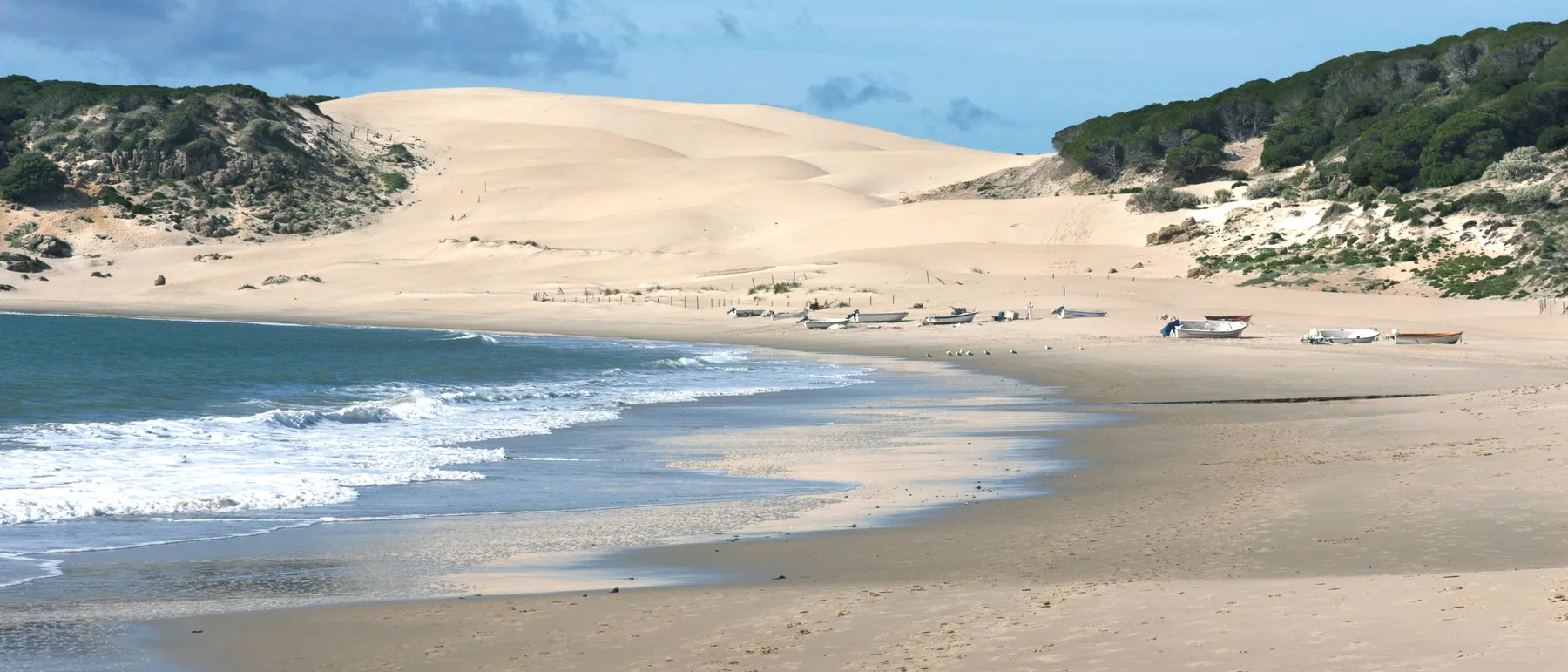
Then there is the coast. Los Lances beach starts at the edge of town and runs for kilometers. Half an hour west is Bolonia, with its 30-meter dune and the Roman town of Baelo Claudia right by the sand. Much of the shoreline is protected inside the Parque Natural del Estrecho, so it still looks wild. Between April and October, boats go out to watch whales and dolphins in the strait.
The wind: kite, levante and poniente
Tarifa is one of the great kitesurfing spots in Europe, with schools all along the coast west of town. There are two winds to know. The levante blows from the east, warm and dry on this side of the strait, and it can blow hard for days. The poniente comes off the Atlantic, cooler and gentler. A strong levante empties the terraces and can delay the ferries to Morocco. Kiters plan their week around it. Everyone else learns which beach is sheltered.
If you love the wind but want warmer winters, the Canary Islands are the other place to look. Corralejo in Fuerteventura and El Médano in Tenerife are wind towns too, and the Canary Islands guide helps you choose an island.
Coworking and coliving in Tarifa
For a town of under 20,000 people, Tarifa is well served. La Cocotera, in the old town, is a hostel, coliving and coworking in one building, with a rooftop that looks at Africa. Desks run from €10 a day to €150 a month plus VAT for a fixed spot. Guests who book direct can use it free when there is room.
Nomadico runs two coliving houses in the old town: Tarifa Hub, near the Puerta de Jerez, and the smaller Tarifa Casa. Between them they have 19 private rooms. The season runs from mid-October to late March, and four weeks cost €688 to €1,128 depending on the room and the month. A community manager organizes events and dinners, and Tarifa Casa has a coworking room. Outside the colivings, TAF CoWorking lists flexible desks at €225 a month, and plenty of people just work from cafés.
Internet is fine for calls and normal remote work. In the old town, ask for a speed test before you sign.
Cost of living in Tarifa
Housing costs less than on the Costa del Sol but more than a town this size suggests, because so much of it is rented to holidaymakers. A realistic monthly budget for one remote worker:
- Rent (1BR, long-term, outside July and August): €650–€900/month
- Coliving instead (private room, October to March): €688–€1,128 for four weeks, coworking included
- Food: around €350/month
- Lunch menu: around €14
- Coworking desk: €150 plus VAT to €225/month
- Home internet: €25–€30/month
- Health insurance (DNV-qualifying): €80–€140/month
- Total estimate (comfortable single, no car): €1,400–€2,100/month
The best long lets appear in September and October, when the summer crowd leaves. Before you sign, check that the contract lets you register your address at the town hall, because you will need that after approval. Renting or buying on the visa explains what to look for in a lease. If you are close to the income line, the income requirements guide explains what the UGE counts, the health insurance guide covers the policy it accepts, and what the visa costs in total adds up fees, translations and apostilles.
Run your numbers
Gross-to-Net Salary Calculator
What your U.S. salary actually leaves in your pocket each month living in Spain.
Tarifa in winter
In July and August the town is full and prices jump. In January and February it can feel almost empty, with some bars and restaurants closed and damp, windy days. Spring and autumn are the sweet spot. If you like calm, winter is a gift, and the colivings keep a social life going. If you need people around you every evening, come for a month in November before you sign for a year.
The ferry to Tangier, and Gibraltar
Ferries leave the port of Tarifa for Tangier several times a day, and the crossing takes about an hour. Lunch in Tangier is a real option. Gibraltar is under an hour by car. One warning that matters for your residence permit: Morocco and Gibraltar are both outside the Schengen area. If your application is still pending, or you do not have your TIE yet, read traveling while your application is pending before you board.
The coast next door
Tarifa is the southern end of the Costa de la Luz, and the towns along it are close enough for a weekend or a move.
- Vejer de la Frontera: a white hilltop town about 40 minutes away, and a lovely place to eat.
- Caños de Meca and El Palmar: long surf beaches near Cape Trafalgar, a little under an hour away. El Palmar has dozens of surf schools and a small coliving with a shared work area.
- Conil de la Frontera: about 50 minutes away, with more coworking than you would expect. CorkerSpace has been open since 2017 (fixed desk €180 a month plus VAT), and the Take Hostel coworking and Nave25 are there too.
Further up the coast, on the Bay of Cádiz, Rota and El Puerto de Santa María sit next to Naval Station Rota, the largest American military community in Spain. The base and its services are for military families and authorized personnel, so a civilian remote worker should plan like anyone else.
Inland, the hills start quickly. Benarrabá, a village in the Genal Valley that welcomes remote workers, is about an hour and three-quarters away by car. Rural Spain for remote workers covers other villages like it.
Airports, flights home and healthcare
Gibraltar airport is about 45 km away, but its routes go only to the UK. Jerez is about an hour and forty minutes by car, Málaga a little over two hours and Seville about two and a half. Most travelers from the U.S. and Canada connect through Madrid or another European hub. Málaga has had a seasonal summer nonstop to Newark, so check the current schedule.
Tarifa has a public health center for everyday care. The nearest public hospital is Hospital Punta de Europa in Algeciras, and the private Hospital Quirónsalud Campo de Gibraltar in Palmones has a 24-hour emergency department. How health cover works for permit holders is in healthcare on the Digital Nomad Visa.
Filing the Digital Nomad Visa from Tarifa
The UGE is a single national unit, so a file from Tarifa goes to the same place and takes the same time as one from Madrid, around 20 business days. If you are already in Spain, file with enough Schengen runway left; the Schengen counter does the math. The steps, in order, are in how to apply, step by step.
Once you are approved, register on the padrón at the Ayuntamiento de Tarifa (the empadronamiento guide explains what to bring). Then book the fingerprint appointment for your TIE at a Policía Nacional office in Cádiz province, within the deadline in your resolution, usually one month. Your first 30 days covers the rest.
Is Tarifa right for you?
Tarifa suits people who want the sea at the door and a small international community where faces become familiar fast. It is harder for families, because there are no international schools in town. For that, look at Sotogrande, an hour east. If you need more city around you, Málaga and Seville are two to two and a half hours away, and Granada is about three and a half. For the Costa del Sol, Marbella is the closest, and Fuengirola, Mijas and Benalmádena are just under two hours away.
Still comparing? The best cities in Spain for digital nomads puts them side by side, and the city map shows them all. If you are an American retiring rather than working, the Non-Lucrative Visa is your route, and Tarifa works for that too. Retiring in Spain from the U.S. walks you through it.
Living in Tarifa does not change the visa itself. Start with the free assessment and I will tell you within 24 hours whether your profile fits and what to order first.
It is if you love the sea, the outdoors and a small town where faces become familiar fast. The trade-offs are the wind, a very quiet winter and rents that are high for a town of about 18,600 people, because so much housing goes to holiday lets. There are no international schools in town.
A one-bedroom of 50 to 70 m² on a long lease runs about €650 to €900 a month, based on Engel & Völkers' November 2026 asking rents for the municipality. With food, coworking, home internet and health insurance, one person living comfortably without a car should plan on about €1,400 to €2,100 a month.
Windy on most days. The levante blows from the east, warm and dry, and it can blow hard for several days in a row. The poniente comes off the Atlantic, cooler and gentler. A strong levante can delay the ferries to Morocco, so locals learn which beach is sheltered and plan around it.
Quiet and mild. In January and February some bars and restaurants close and the days can be damp and windy. The Nomadico colivings open from mid-October to late March, so there is still a social life. Spring and autumn are the easiest seasons.
Yes. La Cocotera, in the old town, charges from €10 a day to €150 a month plus VAT for a fixed desk. TAF CoWorking lists desks at €225 a month, and the Nomadico coliving has a coworking room for its residents.
Yes. Ferries leave Tarifa for Tangier several times a day and the crossing takes about an hour. Morocco is outside the Schengen area, so if your residence application is pending or you do not have your TIE yet, check the travel rules before you go.
Yes. The file goes to the UGE, a single national unit, so the documents and the timeline of around 20 business days are the same anywhere in Spain. Locally, you register on the padrón at the Ayuntamiento de Tarifa and book your TIE fingerprints at a Policía Nacional office in Cádiz province.
Last updated: 28 November 2026.