Is Fuerteventura good for remote work?
If your job is on a laptop and your heart is in the sea, yes. You can take a call at nine, paddle out at one and be back at your desk by three, without a car if you live in Corralejo. Hello Canary Islands, the islands' official tourism site, lists the coworkings and colivings for remote workers on the island, and most of them are in La Oliva. English is everywhere. Outsite’s island guide, updated in December 2025, describes the community as mostly British, German and Scandinavian, so a North American accent still stands out a little.
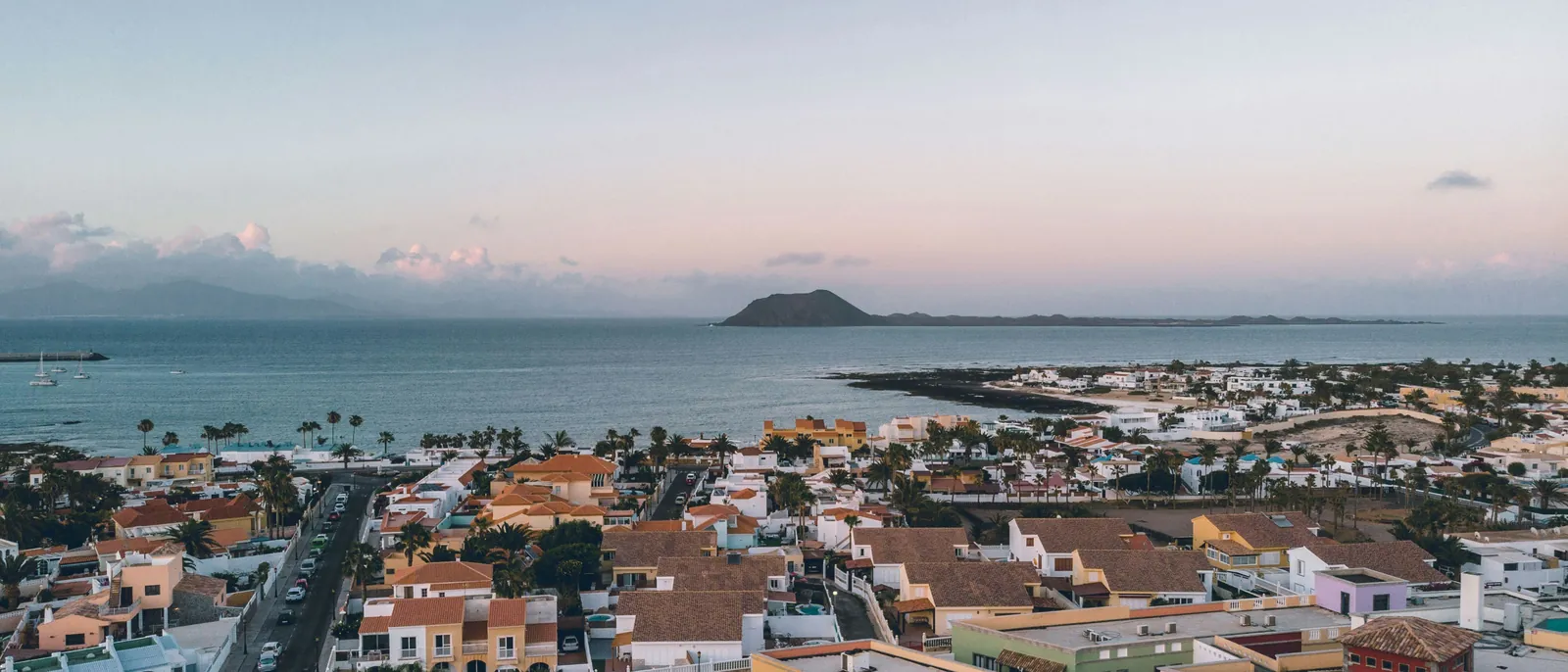
Then there is the landscape. The Corralejo Natural Park runs for kilometers of pale dunes down to the Grandes Playas. The little island of Lobos sits just offshore, a short boat ride away with a free permit from lobospass.com. Ordinary Saturdays feel like a holiday.
Compared with Las Palmas, this is smaller and wilder. You trade a city of 380,000 people for a beach town where the cashier knows you by the second week. If you are still choosing an island, the Canary Islands guide puts all of them side by side.
Corralejo, Lajares or El Cotillo: where to live
- Corralejo: The base for most people. Walkable, with the harbor, supermarkets, the health center, the coworkings and the ferry to Lanzarote. Busy with visitors, and the easiest place to live without a car.
- Lajares: A small inland village about ten minutes away, known for its surf community and its cafés. Quieter than Corralejo. You will want a car or a bike.
- El Cotillo: A fishing village on the northwest coast, with the calm lagoons of La Concha and the best sunsets on the island. The slowest pace of the three. A car is essential.
A good plan is a first month in Corralejo, then a long lease wherever you felt most at home.
Cost of living in Fuerteventura
Idealista’s asking rents for La Oliva rose 8.1% in the year to September 2026. A furnished short let usually costs more than a long lease. These are the figures I could confirm, each with its source and date.
- Rent (1BR, long-term, La Oliva): €950–€1,300/month (idealista’s September 2026 average of €18.8 per m², applied to 50 to 70 m², about 540 to 750 sq ft)
- Coliving: a private double from €50 a night at Coco Surfhouse, coworking included (published rates, November 2026)
- Coworking: €150/month at Surfescape in Lajares; €240.75/month for the open space at CoNomad in Corralejo (published rates, 2026)
- Transport: a car makes life much easier outside Corralejo; Tiadhe buses link Corralejo with Puerto del Rosario
- Health insurance: needed with a Certificate of Coverage, from an insurer authorized in Spain, and not needed if you are in RETA; the health insurance guide compares the options
Arriving on a monthly coliving or a short let and house-hunting from there is usually calmer than signing from abroad. The renting versus buying guide explains what landlords ask for. Rent does not change the visa math: the income you must prove is the same national figure, set out in the income requirements guide.
Run your numbers
Gross-to-Net Salary Calculator
What your U.S. salary actually leaves in your pocket each month living in Spain.
Coworking, coliving and internet
These spaces were operating in 2026, by their own websites or recent guest reviews:
- CoNomad (Corralejo): An ocean-view open space, a focus room, private cabins and a phone booth on Avenida Juan Carlos I. Day pass €16.05.
- Surfescape (Lajares): Coworking and coliving with more than 50 desks, 150 Mbps, a café and a pool. Open weekdays from 8 a.m. to 10 p.m.
- Coco Surfhouse (Corralejo): A small surf house with a pool, a rooftop and coworking included in every stay.
- Banama Coliving (Corralejo): Shared houses two minutes from the beach, with a coworking room open around the clock, external monitors, free yoga and a family-style dinner every Wednesday.
- Amazzzing Coliving Hub (Corralejo): By the harbor, with shared workspaces and a weekly program of yoga, surf trips and rooftop barbecues.
Prices change often, so check before you book. If your job lives on video calls, ask for a speed test on the desk you will actually use.
Surf, kite and how windy it really is
The wind is the island’s signature. The trade winds blow hardest in summer, and the UK Met Office describes August as the windiest month. That is when Flag Beach in Corralejo fills with kites and windsurfers, and the tourism board rates it suitable for all levels. Surfers head to the Grandes Playas and to the reefs and beaches of the north coast toward El Cotillo. A local school will tell you which spot suits you that week. For a calm swim, La Concha in El Cotillo is the place. At home, a sheltered terrace is worth asking about.
If wind and water are the point, Tarifa, at the southern tip of the mainland, is the other kite town worth a look.
Weather in Fuerteventura
The official weather station at Fuerteventura Airport records average highs of about 21°C (69°F) in January and 28°C (82°F) in August. It gets under 100 mm of rain a year and more than 2,800 hours of sun (1981–2010 normals). You will rarely need a coat and you will always need sunscreen.
Flights from the U.S. and Canada, and getting around
Fuerteventura Airport (FUE) is next to Puerto del Rosario, about 40 minutes by car from Corralejo. There are no direct flights from the U.S. or Canada, so most people connect through Madrid or another European hub. Air Canada’s winter nonstops from Toronto and Montreal go to Tenerife, not here. From 13 December 2026, British Airways adds a twice-weekly flight from London Heathrow.
There is no direct bus from the airport to Corralejo, and most residents end up with a car, so read the driver’s license guide early. From Corralejo harbor, ferries reach Playa Blanca in Lanzarote in 25 to 35 minutes, depending on the boat.
Healthcare and schools
Corralejo has a public health center, and La Oliva, Lajares and El Cotillo each have a local clinic. A second Corralejo health center, with an urgent-care unit, had its first stone laid on 1 October 2026. Building is planned to take 23 months. The island’s main hospital, the Hospital General de Fuerteventura, is in Puerto del Rosario, about 40 minutes away. The healthcare guide explains when you can use the public system.
Public schools teach in Spanish. I could not find a British or international school on Fuerteventura; the nearest is on Lanzarote. If an English-language school matters, Las Palmas is the better Canary base. The family guide covers how a spouse and children join you.
Taxes in the Canary Islands: IGIC and Beckham
The Canaries are fully Spain and fully Schengen, but instead of IVA at 21% they use IGIC at 7%. A self-employed person billing a client in the Canaries charges 7% IGIC. Services billed to businesses outside Spain stay outside IGIC, and an employee has no invoices at all. Ask your gestor to confirm they file the Canary returns.
IRPF works as on the mainland, with the Canaries setting the regional half. The Beckham Law applies here as in Madrid, because the islands use the common tax system. Only the Basque Country and Navarre, with their own foral systems, fall outside it. Freelancers can follow the autónomo guide.
Filing the Digital Nomad Visa from Fuerteventura
The UGE is a single national unit in Madrid. It has 20 business days to decide, and a file sent from Corralejo goes into the same queue as one from the capital. If you are on the island as a visitor, file with plenty of Schengen time to spare; the 90-day timing guide shows how. The steps are in how to apply, step by step, and filing in Spain or at a consulate compares the two routes.
With an address, you register on the padrón at La Oliva town hall. After approval, you book the fingerprint appointment for your TIE with the National Police in Puerto del Rosario, within the deadline in your resolution, usually one month. I send you the EX-17 and the fee form already filled in. The first 30 days guide covers both appointments. Canadian passport holders can read the Canada page for what changes. If you are an American who is retired or lives on savings, the Non-Lucrative Visa is the route.
Is the north of Fuerteventura right for you?
It is a lovely fit if you are single or part of a couple, work well on your own and want the ocean in every day. It is a harder fit if you need a major hospital nearby, an English-language school or a direct flight home. Then look at Las Palmas or Tenerife. If it is the slow pace you are after more than the surf, the rural Spain guide covers villages that welcome remote workers, Benarrabá in the hills of Málaga among them. Every option sits side by side in the best cities for digital nomads and on the cities map.
Living in Fuerteventura does not change the visa itself. Start with the free assessment and I will tell you within 24 hours whether your profile fits and what to order first.
Questions about living in Fuerteventura
Yes, with a residence permit. A U.S. or Canadian passport gives you 90 days in any 180 as a visitor. To stay longer while you work remotely for a company or clients outside Spain, you apply for Spain’s Digital Nomad Visa, which can be filed from inside Spain. Fuerteventura follows the same national rules as Madrid. Americans who are retired or live on savings use the Non-Lucrative Visa instead.
Corralejo is the easiest start. It is walkable, has the coworkings, the supermarkets, the health center and the ferry, and you can live there without a car. Lajares is a small surf village about ten minutes inland, quieter and very social, but you need a car or a bike. El Cotillo is the calmest of the three, with lagoons and sunsets on the west coast, and a car is essential. Many people spend a first month in Corralejo and then choose.
Rent is the big number. idealista’s September 2026 asking price for La Oliva, the municipality of Corralejo, Lajares and El Cotillo, was €18.8 per square meter. For a one-bedroom of 50 to 70 m² (about 540 to 750 sq ft) that is roughly €950 to €1,300 a month on a long lease, and furnished short lets ask more. A coworking membership runs from €150 a month in Lajares to about €240 in Corralejo. Add a car if you live outside Corralejo and, if a Certificate of Coverage keeps you out of the public system, private health insurance from an insurer authorized in Spain.
It is windy, and that is why kiters and windsurfers love it. The trade winds blow hardest in summer, and the UK Met Office describes August as the windiest month. Most residents simply plan around it: a sheltered terrace at home, the beach on the calmer side of the day, and La Concha in El Cotillo when you want a quiet swim.
No. You connect in Madrid or another European airport. Air Canada’s winter nonstops from Toronto and Montreal land in Tenerife, not Fuerteventura. From 13 December 2026, British Airways adds a twice-weekly flight from London Heathrow, which helps if you already route through London.
Last updated: 28 November 2026.