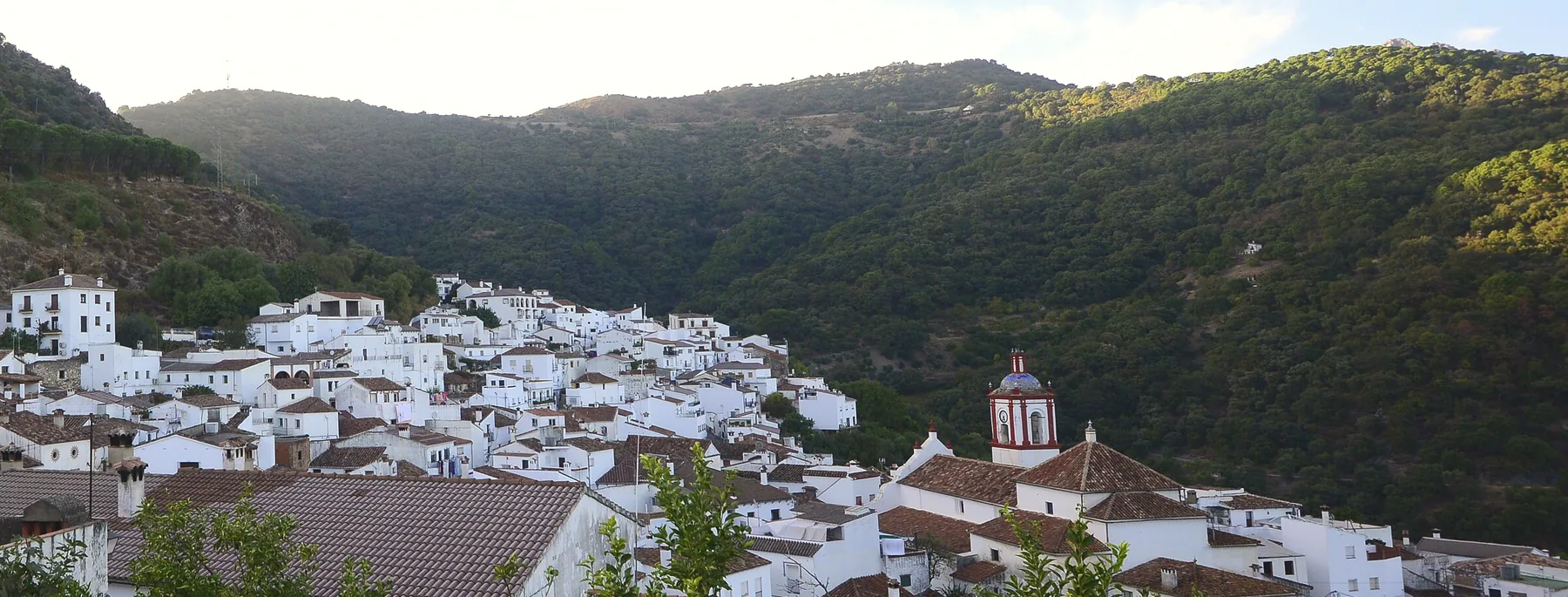
Where Benarrabá is and how to get there
Benarrabá sits at about 480 meters in the Genal Valley, part of the Serranía de Ronda. Its white houses look out over chestnut and cork oak woods. INE counted 457 residents on 1 January 2025.
The city of Málaga is about 130 km away by road, the airport about 125 km and Ronda 37 km. Allow about an hour and three-quarters by car from Málaga airport, because the last stretch is a mountain road. The nearest train station, Cortes de la Frontera, is 20 minutes away. You will want a car, so check how long your U.S. license works in Spain. The turn for the village is on the A‑369, the road between Ronda and Gaucín.
Every autumn the chestnut woods of the valley, known as the Bosque de Cobre, turn copper. Close by, in the Alcornocal de Benarrabá, a grove of huge old cork oaks, the bark is stripped once every nine years.
How Benarrabá became a remote work village
In 2021 the village opened its Digital Social Innovation Centre in a restored house from 1789, with fiber on all three floors. That same year it was one of the 27 founding towns of the Red Nacional de Pueblos Acogedores, a network of rural towns that welcome remote workers.
Rooral came next. Its two founders set it up after one of them had spent years working remotely around the world. It brings small groups of remote workers to live in a village for a few weeks, always by agreement with the town hall and the neighbors. Benarrabá became its first permanent base.
According to The Objective (December 2025), 52 remote workers from 19 countries came in 2025, the third year in a row with groups, and they stayed 24 days on average. One of them, an artist, painted portraits of 45 residents.
Others noticed too. In June 2026 the Junta de Andalucía picked Benarrabá, with Zahara de la Sierra and Órgiva, as a pilot town for a program that trains local staff as digital hosts who help newcomers with paperwork. In August 2026 SumUp put it on its list of the ten best places in Spain to work remotely, El Español reported. Neither comes with money for newcomers, as the guide to regional programs explains.
Rooral stays: what they are like and what they cost
Stays last from two weeks to two months, in spring and autumn, with six to twelve people in the village at a time (VnExpress, August 2026). You live in one of three village houses, in a single or double room, and work from a coworking space in the center of the village. When we checked on 28 November 2026, Rooral’s website listed private rooms from €43 a day and shared rooms from €30.
Work is only part of the day. Euronews (July 2024) described remote workers making goat’s cheese, learning how cork is harvested, helping on farms and sharing dinners with older residents. “We advance at the speed of trust,” one of Rooral’s founders told the outlet. A neighbor put it more simply: “They interact wonderfully with our people.”
Internet and places to work
El Español reported in August 2026 that the village has fiber and 4G coverage. Rooral advertises 1 Gb fiber in its coworking space.
You can also come on your own. The village’s Punto Vuela, part of the Junta’s network of digital centers, has a coworking area at Calle Mesón 10, and the network’s rules make access free. It opens about four hours a day, some days in the morning and some in the afternoon, so check its page before you go.
Living in Benarrabá on the Digital Nomad Visa
A few weeks in the village is a visit. Living there takes a residence permit. For a U.S. or Canadian remote worker, the natural route is Spain’s Digital Nomad permit. You keep working for your employer or clients outside Spain and choose where in Spain to live. It can be filed from inside Spain, at the UGE, and a village address does not change what the application has to prove.
The step-by-step guide walks you through it, with separate guides on the income threshold and health insurance. Once you have a home in the village, you register on the padrón at the town hall, as the empadronamiento guide explains.
Still deciding where to land? The rural Spain guide covers other villages that welcome remote workers, from Galicia to Cantabria. If you would rather live by the sea, the coast is not far: read the guides to Málaga, Fuengirola, Mijas and Benalmádena and windy Tarifa, or see them side by side in the city comparison.
If Benarrabá is on your list, the free assessment tells you whether your work and income fit the permit before you spend anything.
Questions people ask
In the Genal Valley, part of the Serranía de Ronda, in Málaga province. It is about 130 km by road from the city of Málaga, 125 km from the airport, and 37 km from Ronda. Allow about an hour and three-quarters by car from Málaga airport. The nearest train station, Cortes de la Frontera, is 20 minutes away, so a car makes life much easier.
An association that brings small groups of remote workers to live in a village for a while. One of its two founders started it after years of working remotely around the world. Benarrabá is its first permanent base, and the stays are organized with the town council and the residents. They last from two weeks to two months, in spring and autumn.
When we checked on 28 November 2026, Rooral’s website listed private rooms from €43 a day and shared rooms from €30 a day. Check the site for current rates and dates before you plan.
The village has fiber and 4G coverage, El Español reported in August 2026. Rooral advertises 1 Gb fiber in its coworking space, and the village’s Punto Vuela digital center has a free coworking area with limited opening hours.
No. Rooral guests pay for their stay, and the Junta de Andalucía’s 2026 pilot invests in local hosts and services, not in payments to newcomers. Our guide to regional programs covers what Spain’s regions do offer.
Yes, if the application meets the requirements. The permit lets someone who works remotely for an employer or clients outside Spain live anywhere in Spain, a village included. It can be filed from inside Spain, at the UGE. Where you plan to live does not change what the application has to prove.
Sources: The Objective, 2 December 2025 · Euronews, 20 July 2024 · El Español, 14 April 2024 and 7 August 2026 · VnExpress, 27 August 2026 · Revista Haz, January 2024 · Rooral, rates checked 28 November 2026 · Euro Weekly News, 7 September 2023 · Red Eléctrica, 24 June 2021 · Junta de Andalucía pilot, 19 June 2026 · Puntos Vuela, Benarrabá and network rules · Benarrabá, digital nomad destination · Andalucía tourism · INE, municipal register at 1 January 2025. Last updated: 28 November 2026.