Which Canary Island is best for remote workers?
Most people arrive thinking of “the Canaries” as one place. After a week they talk about their island. Here is the short version.
| Island | Where remote workers live | Feels like | Main hospital | International schools |
|---|---|---|---|---|
| Gran Canaria | Las Palmas (Las Canteras, Vegueta) | A real city on the beach, the largest community | Two university hospitals in Las Palmas | The widest choice, including an American school |
| Tenerife | South: Costa Adeje, Los Cristianos, El Médano. North: Puerto de la Cruz, La Orotava, La Laguna | Dry sun in the south, green and local in the north | University hospitals in Santa Cruz and La Laguna, Hospital del Sur in Arona | British schools north and south |
| Fuerteventura | Corralejo, Lajares, El Cotillo | Surf towns and long, windy beaches | Puerto del Rosario, a drive from the north | None on the island; the nearest are on Lanzarote |
| Lanzarote | Arrecife, Teguise, Famara | Small and volcanic, with a calm pace | Arrecife | Two British-curriculum schools |
| La Gomera | San Sebastián, Valle Gran Rey | Forest and cliffs, very quiet | San Sebastián (small) | None |
Gran Canaria: the easiest place to land
Las Palmas is a proper city with a life of its own, and it is where the island’s remote workers gather. You can walk from your desk to Las Canteras beach, and most neighborhoods have a coworking space. The Las Palmas city guide covers the neighborhoods and day-to-day costs in detail.
For families it is the strongest island. The American School of Las Palmas offers a U.S. high school diploma with AP courses, and Canterbury School, Oakley College and the British School of Gran Canaria teach the British curriculum. The island’s two big public hospitals, Doctor Negrín and the Insular, are both in the city. idealista puts asking rents in Las Palmas at €14.7 per square meter in October 2026. That is roughly €750 to €1,050 a month for a one-bedroom.
Tenerife: north or south?
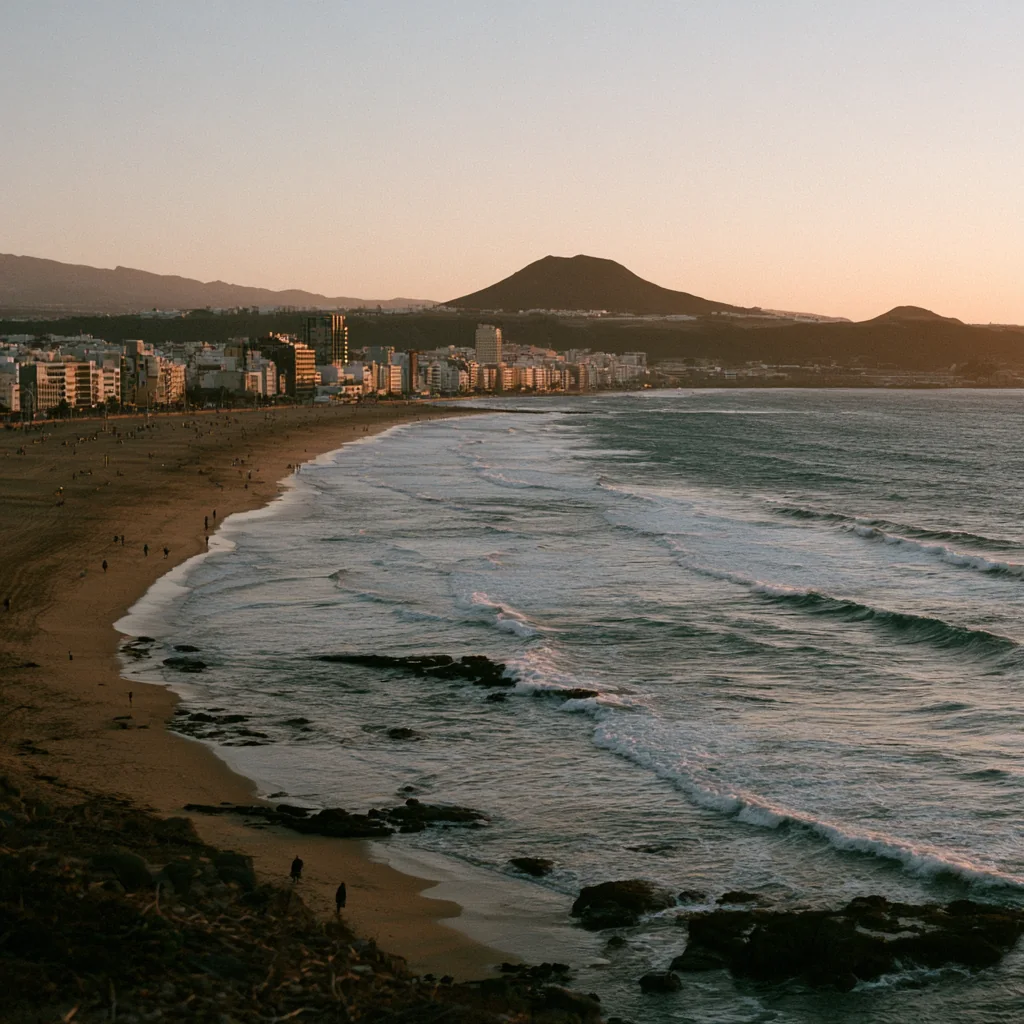
Tenerife splits in two, and people usually fall for one side. The south, around Costa Adeje, Los Cristianos and El Médano, is dry and sunny almost every day. Most of the island’s remote workers meet there. Zen Den Coworking, in the Pueblo Canario center in Costa Adeje, is a well-known meeting point. El Médano adds a kite and windsurf crowd ten minutes from Tenerife South airport. The north is greener and more Canarian, with Puerto de la Cruz, La Orotava and the university city of La Laguna. It is cooler, and you hear more Spanish in the street.
Rents follow the sun. In September 2026, idealista reported €19.0 per square meter in Adeje and €18.9 in Arona, against €16.5 in Puerto de la Cruz and €12.7 in La Laguna. For families, Wingate School in Arona and the British School of Tenerife, on its campuses in La Orotava and Los Realejos, teach in English. The Hospital Universitario de Canarias in La Laguna and Candelaria in Santa Cruz are the big public hospitals, and the Hospital del Sur serves the south. The Tenerife guide goes town by town.
Tenerife Work & Play is the island government’s brand for remote workers, part of its Why Tenerife? program. It has offered newcomers a welcome pack with tips and coworking discounts. Ask what is running before you count on it.
North Fuerteventura: surf first
Corralejo, Lajares and El Cotillo, in the municipality of La Oliva, are where Fuerteventura’s remote workers live. The official tourism site of the Canary Islands lists coworking and coliving spaces there by name, Surfescape and Coworking Punto among them, and Hub Fuerteventura is a large coworking space in the middle of Corralejo. Life runs on surf and wind. It suits people on their own and couples better than families. The general hospital is in Puerto del Rosario, about 40 minutes from Corralejo, and there is no international school on the island. The Fuerteventura guide has the detail.
Lanzarote and La Gomera: the quiet options
Lanzarote has a small community that works well. In Arrecife, the capital, Pitaya Coliving and Coworking Digital Lanzarote are both on the official list. They sit a short drive from the airport and close to the island hospital, Doctor José Molina Orosa. Coworking Guru sits in the old town of Teguise. Famara is lovely for surfing, but a local guide from May 2026 warns that its fiber is patchy and video calls can drop. If your day is full of calls with the U.S., live in Arrecife or Teguise and drive to the beach. For families, the British School of Lanzarote in Tahíche has taught since 1985, and Colegio Hispano Británico in Tías also follows the British curriculum.
La Gomera is a ferry ride from the south of Tenerife. Cactus Coliving in San Sebastián takes remote workers for a few weeks or months, and Valle Gran Rey has a small seasonal crowd. With a small hospital and no international schools, it suits a few months better than a family move.
Canary Islands weather, island by island
Spain’s weather agency, AEMET, publishes averages for 1981 to 2010 at each island’s airport.
| Station | January average | August average | Rain per year |
|---|---|---|---|
| Tenerife South | 18.4°C (65°F) | 24.7°C (76°F) | 132 mm (5.2 in) |
| Gran Canaria | 17.9°C (64°F) | 24.6°C (76°F) | 151 mm (5.9 in) |
| Lanzarote | 17.4°C (63°F) | 25.2°C (77°F) | 111 mm (4.4 in) |
| Fuerteventura | 17.6°C (64°F) | 24.6°C (76°F) | 98 mm (3.9 in) |
| Tenerife North (La Laguna plateau) | 13.1°C (56°F) | 21.2°C (70°F) | 520 mm (20.5 in) |
The last row explains the north of Tenerife. That airport sits on the plateau above La Laguna, so the coast at Puerto de la Cruz is milder. Still, the north really is greener and wetter than the south.
Flights home to the U.S. and Canada
For Americans, every trip home has a connection. United flew Newark to Tenerife until spring 2025 and then dropped the route. Today you fly through Madrid or another European hub, and there are frequent flights to the mainland from every island.
Canadians have it easier this winter. Air Canada flies nonstop to Tenerife South twice a week from Toronto from 25 October 2026 and weekly from Montreal from 31 October, until late April 2027. The page for Canadians explains what changes in a Canadian file.
Your route matters for the visa too. If you file from inside Spain, you need proof of the day you entered the Schengen Area. Connect in Madrid and your boarding passes do the job. Connect in Frankfurt, Paris or Amsterdam and you must also file a declaration of entry within three days, as the proof-of-entry guide explains. Keep every boarding pass, in paper and as a PDF.
Rent and cost of living in 2026
The Fundación Alquiler Seguro barometer for the third quarter of 2026 puts the average rent at €1,240 a month in the province of Santa Cruz de Tenerife and €1,183 in the province of Las Palmas, which covers Gran Canaria, Fuerteventura and Lanzarote. Long-term flats are scarce. In the first quarter of 2026, 18% of the homes rented through idealista on Gran Canaria, Fuerteventura and Lanzarote were listed for less than a day. Book a furnished place for your first month and hunt for the long lease once you are there.
Locals feel the housing shortage every day, and the Canary government has declared a housing emergency. A long lease and some Spanish go a long way with your neighbors.
One small surprise: online orders from the mainland go through customs paperwork, and above €150 the Canary IGIC applies. Some Spanish shops do not ship to the islands at all. For the rest of the budget, the cost guide and the cost-of-living tool help.
Taxes in the Canary Islands: IGIC, income tax and Beckham
IGIC instead of VAT. The Canary Islands have their own sales tax, IGIC, with a general rate of 7% against Spain’s 21% VAT. If you are an employee, you send no invoices and never deal with it. A freelancer who bills U.S. businesses charges no IGIC on those invoices, just as there would be no VAT on the mainland. Clients based in the Canary Islands are different. Those invoices usually carry 7% IGIC, declared on Modelo 420. A business client on the mainland normally accounts for Spanish VAT itself. The Spanish clients guide explains the 20% limit.
Income tax. IRPF is Spain’s income tax, and half of it follows each region’s scale. The Canary budget law for 2026, Ley 9/2025, sets the regional scale from 9% to 26%.
Beckham works here. The Beckham regime is a state regime, so it applies in the Canary Islands exactly as in Madrid. You pay a flat 24% on employment income up to €600,000, and the regional scale drops out. It covers employees and company directors, not most freelancers. It does not exist in the Basque Country or Navarre, which have their own tax systems. You choose it within six months of starting your activity in Spain, on Modelo 149. Americans still file a U.S. return and credit the Spanish tax, as the U.S. tax guide shows.
The ZEC. The Canary Islands Special Zone offers a 4% corporate tax to companies that meet its job and investment conditions. It is built for companies and rarely matters to someone moving with a laptop. The regional programs guide puts it next to the other incentives in Spain.
Estimate your tax
Beckham Law Tax Calculator
Compare what you’d keep under Spain’s 24% flat expat rate vs. the standard progressive rates.
Do you need a visa to live in the Canary Islands?
Yes, for anything longer than a visitor’s 90 days in any 180. It is the same visa as anywhere in Spain, and living on an island changes nothing in the application. It goes to the UGE in Madrid, the same income bar applies (€2,849 a month in 2026, about $3,300; the figure changes for files lodged from January 2027) and the same documents. You can file from inside Spain while you are there legally as a visitor, from an apartment in Las Palmas or Costa Adeje, or through a consulate before you leave. The Schengen counter keeps track of your visitor days.
A W‑2 employee keeps paying U.S. Social Security with a Certificate of Coverage, and someone employed by a Canadian company stays in the CPP with the CRA’s certificate. A freelancer registers as self-employed in Spain, and the 1099 contractor guide explains it. If a Certificate of Coverage keeps you out of the Spanish system, your health insurance must come from an insurer authorized in Spain, whatever the island, as the insurance guide sets out. If you register in RETA, or your employer registers you in Spain, you need no private policy.
After approval, two errands happen on your island. You register at the town hall (empadronamiento) and you give your fingerprints for the TIE at the National Police office that handles foreigners. The first 30 days guide lists the rest.
Retiring, or living on savings? Americans can use the non-lucrative visa instead, applied for at the Spanish consulate in the U.S. before the move. The guide to retiring in Spain from the U.S. walks through it.
So, which island?
- Moving with children: Las Palmas, or the south or north of Tenerife near a school.
- Calls with the U.S. all afternoon: Las Palmas, Costa Adeje or Arrecife, where fiber is easy.
- Surf before work: Corralejo or El Médano. On the mainland, the Tarifa guide covers Spain’s kite town.
- Flying home to Canada: the south of Tenerife, near the airport.
- Quiet and Spanish life: La Laguna, La Orotava or Teguise.
If the islands are one option among several, the best cities guide compares them with the mainland, and all the city guides are in one place. Would you rather trade the beach for a village? The rural Spain guide covers villages that welcome remote workers, Benarrabá in Málaga’s Genal Valley among them.
Questions people ask
Yes. The Canary Islands are part of Spain and of the Schengen Area, so there is no separate island visa. To stay longer than 90 days in any 180 you need a Spanish residence permit, and remote workers use the Digital Nomad Visa. It goes to the same national office in Madrid, the UGE, with the same income and documents, whichever island you choose. After approval you register with your town hall and collect your residence card at the National Police office on your island.
It depends on how you live. Gran Canaria, around Las Palmas, has the largest remote-work community and the most schools. The south of Tenerife has the sunniest weather and the only nonstop flights to North America, from Canada. North Fuerteventura suits surfers and people on their own. Lanzarote is smaller and quieter. La Gomera suits a few quiet months in nature.
One hour behind mainland Spain, the same time as London and Lisbon. Most of the year 9 a.m. in New York is 2 p.m. on the islands, so the U.S. morning falls in your afternoon. For a few weeks in March and in late October, while the U.S. and Europe change their clocks on different dates, the gap is an hour shorter.
Not at the moment. United stopped flying Newark to Tenerife in spring 2025, so Americans connect through Madrid or another European airport. From Canada, Air Canada flies nonstop to Tenerife South from Toronto and Montreal in the winter season, from late October 2026 to late April 2027.
The sales tax is. The islands use IGIC, with a general rate of 7% instead of Spain’s 21% VAT. Income tax is the Spanish one, with the Canary Islands' own scale on the regional half, from 9% to 26% in the 2026 budget law. The Beckham regime applies on the islands exactly as on the mainland, with a flat 24% on employment income up to €600,000. It does not exist in the Basque Country or Navarre, which have their own tax systems.
idealista puts asking rents at €14.7 per square meter in Las Palmas de Gran Canaria (October 2026). On Tenerife its September 2026 report gives €19.0 in Adeje, €18.9 in Arona, €16.5 in Puerto de la Cruz and €12.7 in La Laguna. For a one-bedroom of 50 to 70 square meters (about 540 to 750 square feet) that is roughly €750 to €1,050 a month in Las Palmas and €950 to €1,350 in Costa Adeje. Long-term flats go fast, so start looking before you fly.
Tell me in the free assessment how you work and which island you have in mind. I reply in writing within 24 hours with whether your profile fits and what to order first.
Sources: idealista rental price reports, September and October 2026 · Fundación Alquiler Seguro barometer, Q3 2026 (RTVC, 19-10-2026) · AEMET climate normals 1981-2010 · Air Canada, 6 April 2026 · Agencia Tributaria Canaria, IGIC · ATC, imports above €150 · KPMG on Ley 9/2025 (January 2026) · idealista Q1 2026 study (La Voz de Lanzarote, 10-06-2026) · Turismo de Canarias, remote working spaces · Ley 28/2022 (BOE). Coworking spaces and schools were checked in November 2026; confirm hours and prices with each one. This guide is general information, not tax advice. Last updated: 28 November 2026.