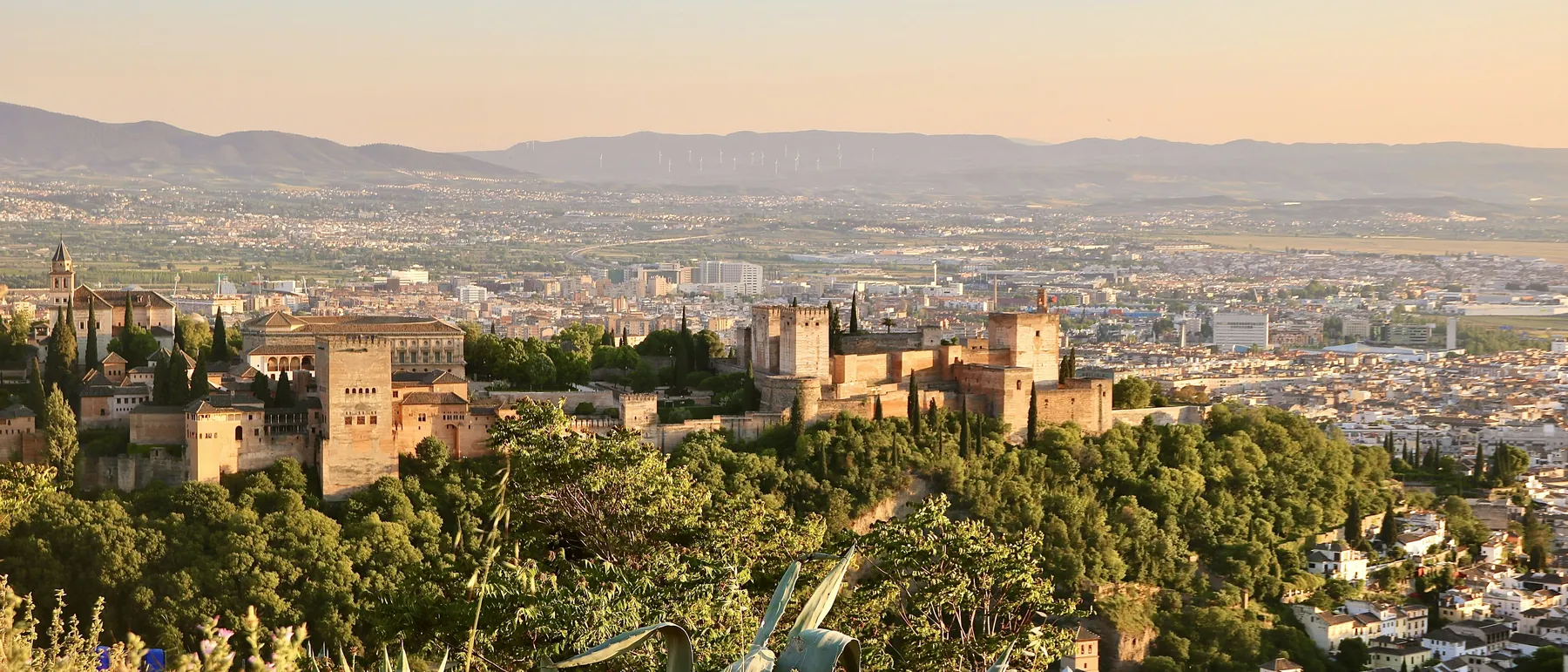
Why Americans and Canadians choose Granada
You can cross the center on foot. The Sierra Nevada rises behind the rooftops, with snow on its peaks in winter. In many bars a small tapa still arrives with each drink, free.
The University of Granada shapes the place. It is one of the largest in Spain and a long-standing Erasmus destination, so the center feels young and there are plenty of schools where you can learn Spanish. About 700 U.S. citizens were registered in the city on 1 January 2026, according to INE, and some of them are likely students. The settled English-speaking community is smaller than on the Costa del Sol. This is a Spanish city first.
The city council runs its own information site for digital nomads, with the local paperwork in one place.
Where to live in Granada
- Centro (Cathedral, Gran Vía, Puerta Real): Flat and walkable, with everything at hand. The most expensive part of the city per square meter.
- Realejo: The old Jewish quarter below the Alhambra. Tapas bars and an artistic feel. Steep in places, so walk it before you sign.
- Albaicín: The Moorish quarter, on the UNESCO list, with the Alhambra views you know from photos. Tourist demand pushes rents up. The cobbled lanes are steep and cars barely get in, which makes it hard with luggage or a stroller.
- Zaidín and Genil: South of the center. Newer, flatter, quieter and cheaper, close to parks and the health-sciences campus. The practical pick for families.
- Ronda and Beiro: Student and residential districts with good value, shops and parks.
Cost of living in Granada
These are the monthly costs for one person that I could tie to a published source:
- Rent (1BR, 50–70 m²): €550–€750/month
- Utilities: €120–€208/month for an 85 m² flat. A one-bedroom sits near the low end, more in winter with electric heating
- Home internet: about €25/month
- Transport: about €25/month for an unlimited city bus pass, or €40 for the metro
- Coworking desk (optional): €120–€140/month plus VAT, about €145–€170 all in
- Rent, utilities, internet and transport: about €720–€1,020/month
Food, eating out and a phone come on top. Health insurance depends on your route (see below). Even so, rent this low leaves a lot of room under the visa’s income threshold. For the visa side of the budget, see what the visa costs in total.
Finding the flat takes work. Asking rents hit a record €10.9/m² in August 2026, according to idealista. Many landlords ask for a Spanish payslip, which you will not have as a remote worker. Be ready to offer a larger deposit or a few months up front. The market also moves with the academic year.
Run your numbers
Gross-to-Net Salary Calculator
What your U.S. salary actually leaves in your pocket each month living in Spain.
Coworking in Granada
Coworking here means small independent spaces, mostly in the center. Coworking Catedral, La Variable in the old town and Topyco list desks from €120 to €140 a month plus VAT. Topyco also sells a €13 day pass if you want to try before you commit.
Granada weather: hot summers, cold winters
Granada sits inland, at the foot of the mountains. July averages a 34.8°C (95°F) high and January nights drop to about 0°C (32°F). Many older flats are built for the heat, so winter indoors can feel cold. Ask how the flat is heated before you sign.
Winter also brings the worst air of the year, when the basin traps smoke from traffic and heating. If you have asthma or a sensitive chest, keep it in mind.
The upside of the cold is snow nearby. The Sierra Nevada ski station at Pradollano is about 31 km from the city, according to the Granada tourist board, and buses run up from the main bus station. The coast is about an hour south.
Flying home from Granada
Granada-Jaén airport handled about 1.15 million passengers in 2025, according to Aena, and almost all of them flew within Spain. Nothing flies to the U.S. or Canada. You have three ways out. Fly to Madrid or Barcelona and connect. Take the direct AVE to Madrid, about 3½ hours, and fly from Barajas. Or take the direct ALSA bus to Málaga airport, about 2¼ hours. From Málaga, United runs a nonstop to Newark in summer. It is seasonal, so do not count on it in winter.
Schools and healthcare for families
International schools are fewer than on the coast. Agora Granada College, in Atarfe just outside the city, offers the International Baccalaureate. Almuñécar International School, a British school, is on the coast about an hour away. Confirm curriculum, places and fees with each school directly. For the paperwork, see the visa with family.
Hospitals are a strength. Virgen de las Nieves and the Clínico San Cecilio are public university hospitals, and Vithas and HLA Inmaculada are private. Your route decides your cover. With a U.S. Certificate of Coverage you have no access to the public system and need private health insurance from an insurer authorized in Spain. If you register in RETA, or your employer registers you in Spain, you do not need private cover.
Filing the Digital Nomad Visa from Granada
Your file goes to the UGE, a single national unit, so the documents and the timeline of around 20 business days are the same as anywhere. The steps, in order, are in how to apply, step by step. If you are already here as a tourist, the 90-day Schengen window applies, so file with room to spare. Canadians file the same way, with a few different documents explained on the page for Canadians.
Andalusia uses the common Spanish tax system, so the Beckham regime applies here if you qualify. It does not apply in the Basque Country or Navarre, which have their own tax systems. If you are American, it does not replace your U.S. federal return either.
Retiring rather than working? The Non-Lucrative Visa is filed at the Spanish consulate for your U.S. state before you move, and retiring in Spain from the U.S. walks through it. The local steps below are the same.
Padrón and TIE in Granada
The padrón registers your address with the Ayuntamiento. The city’s nomad site says you can do it in person at the Oficina de Atención al Ciudadano or online at sede.granada.org with a digital certificate. Appointments are at citaprevia.granada.org or on 010. Check the documents on granada.org first. The general steps are in how to register on the padrón.
TIE fingerprints are taken at the Oficina de Extranjería, Calle San Agapito 2, within the deadline your resolution sets, usually one month. On the national cita previa site, choose province Granada, that office and «POLICÍA-TOMA DE HUELLAS (EXPEDICIÓN DE TARJETA)». Bring the EX-17 and the 790-012 fee receipt. I send both to my clients already filled in. Collecting the card is a separate appointment. The rest of the first weeks is in your first 30 days.
Is Granada right for you?
Granada suits remote workers and retirees who want a real Spanish city at one of the lowest rents in these guides and can live with a longer trip home. It is a weaker fit if you fly to North America often or need a wide choice of international schools.
If you want the sea, compare Málaga, 89 km away in a straight line, or Fuengirola, Mijas and Benalmádena, where daily life works in English. For a bigger Andalusian city, look at Seville. Zaragoza is the other inland city on the AVE with modest rents. And if even Granada feels too busy, read about Benarrabá, a white village in the Málaga hills, and the wider guide to rural Spain for remote workers. All of them sit side by side in the best Spanish cities for remote workers.
Living in Granada does not change the visa. Start with the free assessment and I will tell you within 24 hours whether your profile fits and what to order first.
Questions about living in Granada
Yes, if you want a walkable Spanish city with low rents and can live with a longer trip home. The English-speaking community is smaller than on the Costa del Sol, and Granada’s airport has no flights to North America, so most trips home start in Málaga or Madrid.
A one-bedroom of 50 to 70 m² rents for about €550 to €750 a month at idealista’s October 2026 asking prices. Add utilities, home internet and a bus pass, and one person’s fixed costs come to about €720 to €1,020 a month before food.
January nights average about 0°C (32°F) at the airport weather station, according to AEMET. Many older flats are built for the heat, so ask how a flat is heated before you sign. The Sierra Nevada ski station is about 31 km away.
Nothing flies there from Granada. You can connect through Madrid or Barcelona, take the AVE to Madrid in about 3½ hours, or ride the ALSA bus to Málaga airport in about 2¼ hours. United’s Málaga to Newark nonstop runs in summer only.
Yes. The file goes to the UGE, a single national unit, so the documents and the timeline of around 20 business days are the same anywhere in Spain. Locally, you register on the padrón with the city council and give your TIE fingerprints at the Oficina de Extranjería on Calle San Agapito.
Last updated: 28 November 2026.